

A chatbot can write a polished paragraph, produce a convincing explanation, and even add citations that look authentic. This is why AI hallucinations explained clearly matters before anyone relies on an answer. The problem is that a confident tone does not prove that the information is true. Sometimes, a chatbot produces a false statement, an invented source, a wrong date, or a quotation that never existed. This behavior is commonly called an AI hallucination.
In this article, AI hallucinations explained means more than simply saying that chatbots “make things up.” The important question is why a system that sounds knowledgeable can still produce unreliable information. Once you understand the mechanism, it becomes easier to use AI tools productively without treating every fluent answer as a verified fact.
The practical lesson behind AI hallucinations explained is simple: use chatbots for drafting, exploring, organizing, and brainstorming, but verify important claims before you repeat, publish, or act on them. AI hallucinations explained properly should lead to better judgment, not fear of every AI tool.
AI Hallucinations Explained: What They Actually Mean
An AI hallucination is a statement or output that appears plausible but is false, unsupported, or inconsistent with the available evidence. It may be a completely invented claim, or it may be a mostly accurate answer that contains one dangerous detail. A chatbot can also hallucinate when it summarizes a document and adds information that was never present in the original.
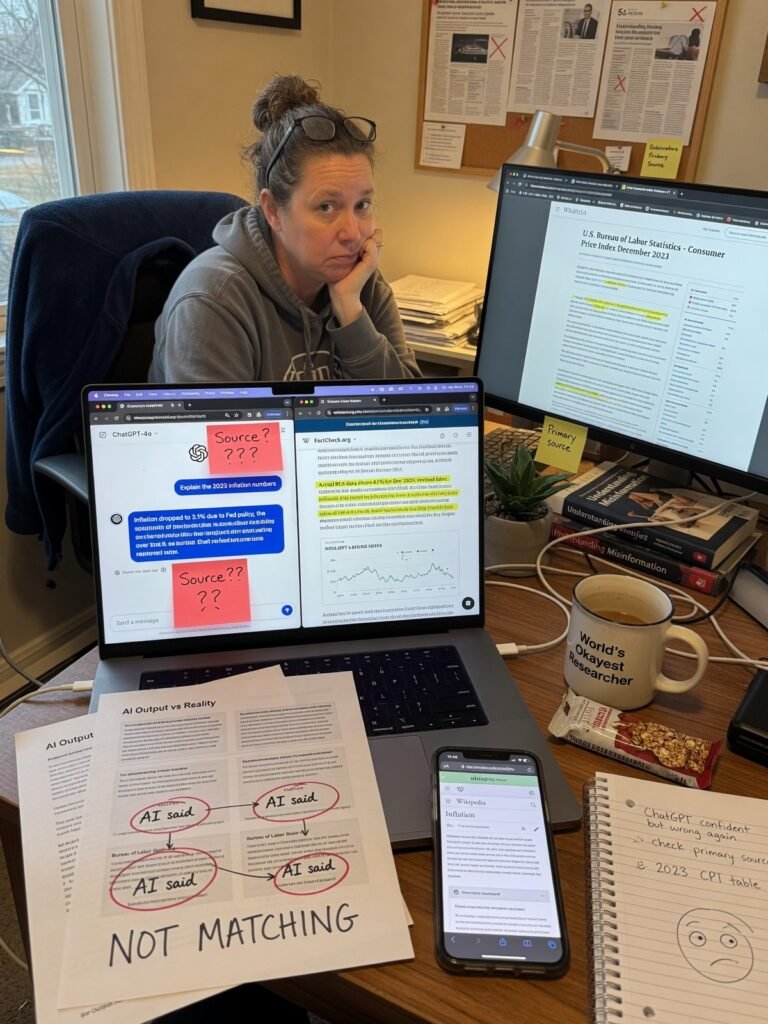
The word “hallucination” is a convenient label, but it does not mean that software is seeing or experiencing something. In other words, AI hallucinations explained does not mean that a machine has a human mind. A language model does not have human beliefs, intentions, or awareness. It generates a sequence of words based on patterns learned during training and the context provided in the conversation. That is why AI hallucinations explained should focus on system behavior rather than human-like motives.
OpenAI describes hallucinations as confident answers that are not true and explains that evaluation systems can unintentionally reward guessing instead of honest uncertainty in its explanation of why language models hallucinate. Google Cloud similarly describes hallucinations as incorrect or misleading results that can arise from incomplete data, weak grounding, incorrect assumptions, and other model limitations in its overview of AI hallucinations.
This distinction is central to AI hallucinations explained because a chatbot may sound certain even when it has no reliable evidence. Confidence is a communication style. It is not a measurement of accuracy.
AI Hallucinations Explained: Why Do Chatbots Invent Information?
They Generate Likely Language, Not Guaranteed Truth
Most large language models are trained to predict what text is likely to come next. This process makes them remarkably good at producing fluent sentences, but fluency and factual accuracy are different abilities. A model can learn that certain names, topics, and phrases often appear together without having a dependable record of every fact associated with them.
Imagine asking a chatbot for the title of an obscure book. If the model has seen several similar titles, authors, and publishing patterns, it may combine those patterns into a title that sounds perfectly reasonable. The result can look like a real book even when no such book exists. This is one of the clearest examples of AI hallucinations explained through probability rather than intention. The same principle is useful whenever AI hallucinations explained content is used to teach beginners about model behavior.
Training Data Is Large but Imperfect
AI systems learn from enormous collections of text and other data. Those collections can include accurate information, outdated information, duplicate claims, missing context, bias, satire, errors, and material that was never designed to be a reliable reference. A model may absorb patterns from all of these sources without having a universal truth detector.
Training data can also be incomplete. A chatbot may know a great deal about a major public event but very little about a small local organization, a new product, or a person with a limited public record. This limitation is a core part of AI hallucinations explained for everyday users. When information is missing, the model may still try to provide a helpful-sounding response rather than stop and say that it does not know.
Prompts Can Be Ambiguous
A vague question leaves room for many interpretations. This is an important starting point when AI hallucinations explained is applied to everyday prompts. If someone asks, “What happened in the case?” the chatbot may not know which case, time period, country, or legal issue the person means. It may silently choose an interpretation and write a confident answer around it.
Ambiguity becomes more dangerous when a user assumes that the chatbot understood a private context that was never explained. Clear prompts reduce confusion, but even a detailed prompt cannot guarantee that every output is accurate. Good instructions improve the conditions for a useful answer; they do not replace verification. That is an essential boundary when AI hallucinations explained is applied to real conversations.
The Model May Lack Current or Grounded Information
A model may have limited access to current events, private databases, specialist documents, or information published after its training period. Even when a chatbot can search the web, the result may depend on which pages it retrieves, how it interprets them, and whether the sources are reliable.
Grounding can help by connecting a response to a defined set of documents, a database, or a retrieval system. This is one of the most practical ideas in AI hallucinations explained for people building safer workflows. However, retrieval is not magic. A system can retrieve the wrong page, misunderstand a passage, cite a secondary summary, or combine several sources incorrectly. The safest habit is to open the source and check whether it actually supports the claim.

The System May Guess Instead of Admitting Uncertainty
OpenAI’s research makes an important point: some evaluation methods reward a correct guess but do not penalize a confident wrong answer enough. In that environment, a model may appear more accurate by attempting an answer instead of abstaining. This helps explain why AI hallucinations explained is also a discussion about incentives and evaluation, not only about training data.
A responsible user should therefore welcome uncertainty. Phrases such as “I cannot verify that,” “the source is unclear,” or “this depends on the jurisdiction” are often more useful than an attractive but unsupported answer. This is the human judgment that AI hallucinations explained should encourage.
Common Forms of AI Hallucinations Explained
AI hallucinations do not always look dramatic. The most dangerous examples often appear as small details inside otherwise useful work. A chatbot may invent a citation, give the wrong publication date, attribute a quotation to the wrong person, or describe a feature that a product does not have.
Another common pattern is the fabricated link. The address may look professionally structured, but the page may not exist or may lead to an unrelated source. Google Cloud specifically notes that generative systems can fabricate web links and add details that were not in an original article in its discussion of hallucination causes.
A summary can also become unreliable when the model fills gaps. This is another everyday example of AI hallucinations explained in practical terms. For example, a user may upload a short report and ask for a summary. The response may correctly capture the main idea but add a statistic, recommendation, or conclusion that the report never made. The output sounds complete, which makes the invented addition easy to miss.
The same risk appears in translations, business research, academic writing, technical explanations, and customer support. These examples make AI hallucinations explained relevant far beyond chatbot experiments. The more specific the claim, the more important it is to verify it. If a sentence contains a name, number, date, quote, legal rule, medical recommendation, or financial figure, treat it as a claim that needs evidence.
7 Powerful Ways to Spot and Reduce AI Hallucinations
Ask the Model to Separate Facts From Uncertainty When Checking AI Hallucinations
Start by asking the chatbot to distinguish verified information, reasonable inference, and uncertainty. You can write: “Separate established facts from assumptions. If you cannot verify a claim, say so clearly.” This does not make the answer automatically correct, but it encourages a more transparent response.
You can also ask the model to identify which parts of its answer require checking. A useful follow-up is: “List the three claims in your response that are most likely to be wrong or outdated.” The resulting list is not proof, but it gives you a practical verification starting point.
Ask for Sources, Then Open Every Important Source
A citation is not evidence until you inspect it. This verification habit is one of the most important actions in AI hallucinations explained for writers and researchers. Ask for the title, author, date, publisher, and direct link, then open the source yourself. Check whether the source exists, whether it says what the chatbot claims, and whether the source is primary or merely repeating another article.
This is one of the most important lessons when AI hallucinations explained becomes a practical workflow. Never assume that a citation is real simply because it contains a journal name, a government website, or a formal-looking DOI. Fabricated citations can imitate the language of real scholarship.
Use Primary Sources for Important Claims
For laws, public statistics, product specifications, scientific findings, financial rules, and health information, look for the original source. That may be a government agency, a university, a standards organization, a research paper, a company’s official documentation, or a recognized professional body.
Secondary articles can help you understand a topic, but primary sources are usually better for checking exact wording and numbers. That source hierarchy makes AI hallucinations explained actionable instead of merely theoretical. If two sources disagree, do not ask the chatbot to choose automatically. Read the relevant passages and consider whether the disagreement comes from different dates, definitions, locations, or methods.
Compare the Answer With Independent Sources
One source can be wrong, outdated, or incomplete. For important claims, compare the answer with at least two independent sources that did not simply copy one another. Independence matters: ten websites repeating the same press release do not provide ten separate confirmations.
A comparison is especially useful when a chatbot gives a precise number or a strong conclusion. In AI hallucinations explained practice, precise claims deserve more scrutiny than broad brainstorming. Ask whether reputable sources report the same number, whether they define the term in the same way, and whether newer evidence changes the conclusion.
Test Specific Details Instead of Accepting a General Summary
General statements can hide specific errors. Break the response into individual claims and verify the parts that matter. If a chatbot says that a company launched a product in a particular year, check the company’s announcement. If it says that a study found a specific result, read the abstract or full paper. If it gives a legal or financial rule, check the applicable official authority.
This approach is slower than copying the answer, but it is faster than correcting a published error later. It is also the clearest workflow AI hallucinations explained can offer to content creators. It also makes AI hallucinations explained useful for real work because the goal is not merely to understand the problem; it is to build a repeatable checking habit.
Provide Source Material and Ask for Bounded Answers
When possible, give the chatbot a document, webpage, transcript, or dataset and ask it to answer only from that material. Tell it to quote the relevant passage or say that the answer is not found in the source. Bounded tasks are easier to verify than broad questions that invite the model to search its entire learned pattern space.
Even with source material, compare the output against the original. AI hallucinations explained responsibly means remembering that document access does not guarantee document understanding. A model can misunderstand a paragraph, merge two sections, or overlook a qualification. Retrieval-augmented systems can reduce some errors, but they do not remove the need for human review. MIT Sloan Teaching + Learning recommends critical evaluation, diversified sources, and retrieval-based tools as ways to navigate hallucination and bias risks in its practical guidance for educators and users.
Slow Down for High-Stakes Decisions
Do not use an unverified chatbot answer as the only basis for a medical decision, legal filing, financial transaction, safety procedure, employment decision, or privacy-sensitive action. In these areas, an incorrect detail can cause real harm even if most of the response is accurate.
For organizational use, a risk-management approach is helpful. This is where AI hallucinations explained connects with accountability, review, and responsible technology governance. The NIST AI Risk Management Framework provides voluntary guidance for identifying and managing risks associated with AI systems. Its Generative AI Profile is designed to help organizations consider risks that are specific to generative systems. Individual users do not need to implement a formal framework for every question, but the principle is valuable: match the level of review to the possible consequences of an error.
Prompt Patterns That Encourage Better Answers
A good prompt does not eliminate hallucinations, but it can reduce ambiguity and make review easier. That practical distinction makes the ideas in AI hallucinations explained useful for people who want safer outputs. It is an important qualification whenever AI hallucinations explained appears in a discussion of prompt engineering. Ask the chatbot to state its knowledge limits, request clarification when the question is unclear, cite sources only when it can provide real links, and mark uncertain claims rather than filling gaps.
A useful prompt might say: “Answer only from the attached report. For every factual claim, quote the supporting passage. If the report does not contain the answer, write ‘not found in the source.’ Do not infer missing details.” This gives the system a narrower task and gives you a clear way to check the response.
Another useful pattern is a two-pass workflow. First, ask the chatbot to produce a draft. Then ask it to audit the draft for unsupported claims, invented citations, missing context, and outdated information. The second pass is not independent fact-checking because it uses the same system, but it can identify obvious weaknesses before you verify the important points yourself.
When a chatbot gives a confident answer to a difficult question, ask: “What would make this answer wrong?” This encourages the model to surface assumptions and edge cases. Treat the response as a review aid, not as a final guarantee.
What AI Hallucinations Teach Us About Trust
The central mistake in AI hallucinations explained is confusing a smooth answer with a reliable answer. Human readers often use tone, detail, structure, and confidence as shortcuts for credibility. Chatbots are very good at producing all four. That makes the technology useful for communication, but it also makes unsupported claims harder to notice.
A better mental model is to treat a chatbot as a fast language-and-reasoning assistant whose output needs an appropriate level of supervision. This is the most useful conclusion from AI hallucinations explained. It may help you generate search terms, organize notes, compare possibilities, create a first draft, or explain a difficult concept. It should not be treated as an automatic authority merely because it responds quickly.

Understanding AI hallucinations explained in this way also changes how you evaluate AI products. Look beyond impressive demonstrations. Ask whether the system shows sources, expresses uncertainty, supports document grounding, logs its outputs, allows human review, and provides controls for sensitive information. Reliability is not a single feature; it is a combination of model behavior, source quality, product design, and user judgment.
How to Use AI Without Losing Your Own Judgment
The safest approach, once AI hallucinations explained is understood, is not to reject AI or trust it blindly. Use it where errors are easy to detect and consequences are limited. Let it help with brainstorming, outlines, formatting, practice questions, or alternative explanations. For claims that affect another person or a significant decision, add human review and source verification.
AI and Privacy: What Happens to Your Data When You Use AI Tools? can help readers consider what information they should avoid sharing with a chatbot. Readers can also explore [The Dark Side of AI: Deepfakes, Misinformation, and What You Can Do] to understand how false information can spread beyond a single chatbot response.
The goal of AI hallucinations explained is not to make every AI interaction slow and suspicious. It is to make verification proportional to risk. A creative headline may only need a quick review. A statistic in a published article deserves a source check. A claim that could influence health, legal rights, finances, safety, or someone’s reputation deserves much more care.
Final Thoughts
AI hallucinations explained simply are confident-looking outputs that are false, unsupported, or incorrectly assembled. They happen because language models generate patterns rather than guaranteeing truth, training data is imperfect, prompts can be ambiguous, information may be missing, and systems may guess instead of admitting uncertainty.
The practical response is clear. Ask for uncertainty, use bounded source material, inspect citations, verify primary evidence, compare independent sources, and slow down for high-stakes decisions. Chatbots can be valuable tools when humans remain responsible for checking what matters.
The best AI user is not the person who never questions a chatbot. It is the person who knows when an answer is useful as a draft, when it needs evidence, and when it should not be trusted without expert review.
Frequently Asked Questions
What are AI hallucinations?
AI hallucinations are false, unsupported, or misleading outputs that a generative AI system presents in a plausible way. They can include invented facts, fabricated citations, wrong dates, false quotations, unsupported summaries, and imaginary links.
Why do chatbots hallucinate?
Chatbots can hallucinate because they generate likely language from patterns in data rather than consulting a perfect database of verified facts. Incomplete training data, ambiguous prompts, weak grounding, outdated information, and incentives to guess can all contribute to incorrect answers.
Can AI hallucinations be completely eliminated?
No system should be treated as incapable of error. Better models, retrieval systems, source grounding, uncertainty handling, and human review can reduce risk, but they do not create a universal guarantee of accuracy. Important claims still need verification.
How can I check whether an AI answer is true?
Separate the answer into individual claims, open every important citation, compare primary sources, check dates and definitions, and look for independent confirmation. Do not rely on a citation merely because it looks formal or includes a familiar institution’s name.
Are AI search tools safe from hallucinations?
Search-connected tools can improve access to current sources, but they can still retrieve weak pages, misunderstand evidence, or summarize a source incorrectly. Search results and citations should be inspected rather than accepted automatically.
Should I use AI for medical, legal, or financial questions?
AI can help you prepare questions or understand general terminology, but it should not replace a qualified professional. For a decision involving health, legal rights, money, safety, or privacy, verify the information with an appropriate official or professional source.