
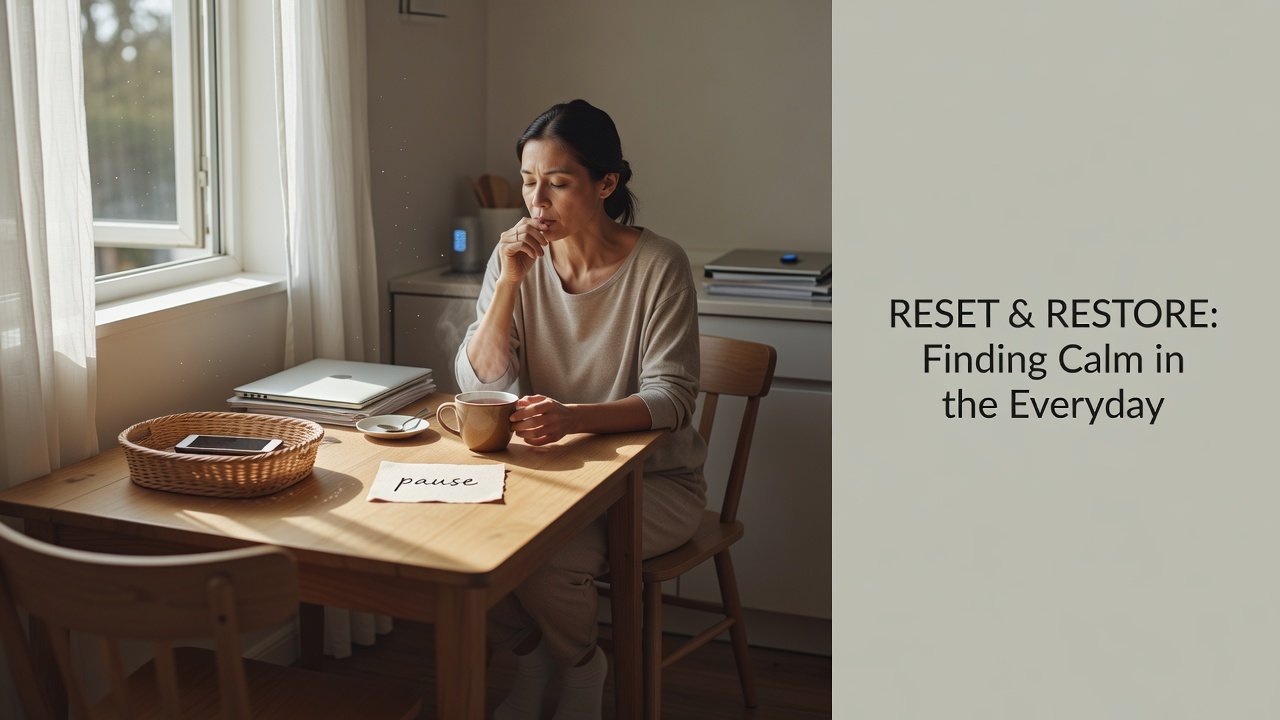
Stress does not always arrive as a dramatic crisis. Sometimes it looks like checking your phone before your eyes are fully open, carrying unfinished tasks from one room to another, eating lunch while answering messages, or lying in bed while your mind continues planning tomorrow. When these small pressures pile up, “just relax” can sound less like advice and more like another demand.
A stress reset is not a promise to eliminate every difficult feeling. It is a deliberate pause that helps you notice what is happening, reduce unnecessary stimulation, and choose your next response with a little more room to think. The reset may take five minutes, a quiet evening, a walk around the block, or a longer conversation with someone you trust. The most useful version is the one you can actually repeat. A repeatable stress reset is more valuable than an ambitious routine that increases pressure.
The Centers for Disease Control and Prevention describes stress as a normal physical and emotional response to new or challenging situations. It also warns that long-term stress can contribute to worsening health problems, which is why managing stress regularly matters rather than waiting until you feel completely depleted. The CDC’s stress-management guidance supports small daily actions such as taking breaks, moving your body, sleeping regularly, connecting with trusted people, and making time to unwind.
This article focuses on everyday stress, not on diagnosing anxiety or treating a mental-health condition. The aim is to give you seven practical ways to create a calmer rhythm while recognizing when self-help is not enough. You do not need to adopt every suggestion. Choose one reset that fits your current capacity and test it gently. A simple stress reset is often easier to sustain than a complete lifestyle overhaul.
What a Stress Reset Can and Cannot Do
A practical stress reset can interrupt an automatic cycle. You may notice tension in your jaw, shallow breathing, racing thoughts, irritability, or the urge to keep consuming information. A pause can help you identify the trigger and decide whether you need movement, rest, boundaries, information, food, connection, or professional support.
It cannot guarantee that a difficult situation will disappear. A reset will not solve an unsafe relationship, remove financial pressure, cure an illness, or replace therapy when you need clinical care. It also does not require you to be positive about something genuinely painful. Calm does not mean pretending that a problem is harmless. It means creating enough steadiness to respond more deliberately.
| A stress reset may help you | A stress reset cannot replace |
| Notice what is activating your body and attention | Medical or mental-health assessment when symptoms persist |
| Reduce avoidable stimulation for a short period | Treatment for an anxiety disorder, depression, trauma, or another condition |
| Create a small transition between work and rest | Practical action on serious problems such as unsafe housing or abuse |
| Choose a healthier next step | Emergency support when you are in immediate danger or considering self-harm |
The World Health Organization’s guide Doing What Matters in Times of Stress emphasizes practical skills that can be practiced for a few minutes each day. That principle is useful here: a reset does not have to be elaborate to be worthwhile.
Seven Ways to Create a More Useful Stress Reset
Start by Naming the Pressure Instead of Fighting It
The first step in a useful stress reset is to identify what your body and mind are responding to. Stress often feels like one large cloud, but it may contain several separate pressures: an overdue task, an unresolved conversation, too many notifications, uncertainty about money, poor sleep, or the belief that you must solve everything immediately.
Try finishing the sentence, “Right now, I feel stressed because…” Do not edit the answer into something impressive. You might write, “I have three deadlines and I am afraid of disappointing someone,” or, “I have been reading bad news for an hour and my body feels tense.” Naming the pressure does not make it disappear, but it turns a vague alarm into information you can work with.
Then separate the problem into what is happening, what you can influence today, and what must wait. If the pressure is a real task, choose the smallest next action. If it is uncertainty, decide when you will review it again. If it is an emotion, give yourself permission to experience it without treating it as a command.
This approach also reduces self-judgment. In a stress reset, noticing the pressure is progress even before the situation changes. Feeling stressed does not mean you are weak or failing at adulthood. It means your system is responding to a demand. Your next decision can be compassionate and practical at the same time.
Use a Short Breathing or Grounding Practice
During a stress reset, when your body is activated, reasoning may feel harder. A brief grounding practice can create a transition between the first reaction and the next choice. You could place both feet on the floor, notice five things you can see, relax your shoulders, and take several slow breaths without forcing your lungs to fill beyond comfort.
Relaxation techniques are intended to bring about the body’s relaxation response, which can include slower breathing, a lower heart rate, and reduced blood pressure. The National Center for Complementary and Integrative Health describes several approaches, including progressive muscle relaxation, guided imagery, and diaphragmatic breathing. Its review of breathing research describes preliminary evidence that slow diaphragmatic breathing may help reduce stress, while also noting that findings vary and no single technique is a universal cure. NCCIH’s relaxation-techniques overview provides a careful explanation.
Keep the practice gentle. If focusing on breathing makes you dizzy, panicked, or more uncomfortable, stop and switch to an external grounding method such as describing objects in the room, holding a cool glass, or walking slowly. You are not trying to perform calmness perfectly. You are giving your attention a safe and manageable place to land.

Make Movement a Transition, Not a Punishment
Stress often leaves people feeling restless and still at the same time, which is why movement can become an important part of a stress reset. Your mind may be racing while your body remains in one chair for hours. A short period of movement can create a physical transition, especially when you use it to close one part of the day and begin another.
You do not need an intense workout. Walk to the end of the street, stretch your back and shoulders, take the stairs if it feels appropriate, dance to one song, or stand during a phone call. The purpose of this part of a stress reset is not to burn off emotion or punish your body. It is to give your nervous system a change of pace and your attention a different sensory experience.
The CDC recommends starting small and building physical activity gradually. A few minutes are still useful when the alternative is remaining locked into an exhausting loop. If you have an injury, chronic condition, significant pain, or a long period of inactivity, choose movement that is appropriate for you and seek professional guidance when needed.
Movement can also expose the difference between physical tiredness and mental overload. After ten quiet minutes outside, you may still have the same problem, but it may feel more specific and less total. That is enough to choose the next step more clearly.
Protect the Transition Between Work and Rest
Many people finish work physically but keep working mentally, so a work-to-rest boundary can make the stress reset last beyond the first few minutes. They carry messages, decisions, unfinished tasks, and other people’s urgency into the evening. Without a transition, the brain receives no clear signal that one role has ended and another has begun.
Create a small closing ritual that marks the boundary. Write down unfinished tasks, choose the first task for tomorrow, clear one visible part of your workspace, and change your lighting or clothes. If you work from home, even a short walk around the block can separate work time from personal time. If you study, place your materials in one location and give yourself a clear stopping point.
A boundary is not a rejection of responsibility. It is a way to prevent every responsibility from occupying every hour. This is especially important when your stress comes from constantly switching between roles. You may not control the number of demands in your life, but you can sometimes control how often they follow you from one setting into another.
If your stress is connected to unfinished tasks and avoidance, read How to Stop Procrastinating and Get Things Done. That related article can help you connect emotional overload with practical task design without treating stress as a character flaw.
Reduce the Information That Keeps Your Body on Alert
A steady stream of bad news, arguments, alerts, and short videos can keep your attention in reaction mode. Being informed is valuable, but constant exposure is not the same as responsible awareness. Sometimes a stress reset requires reducing the amount of information entering your mind.
Choose a few specific times to check news and messages instead of responding to every interruption. Turn off non-essential notifications, move emotionally intense apps away from your home screen, and avoid beginning or ending the day with an uncontrolled feed. You can still follow important events while creating space for your mind to recover.
Pay attention to the effect rather than blaming the technology. Does a particular account help you understand an issue, or does it repeatedly leave you angry and unable to concentrate? Does a group chat provide connection, or does it keep reopening the same conflict? The answer may change from day to day, so treat this as an observation rather than a permanent rule.
A calmer information routine is not avoidance when it helps you return to important decisions with better attention. It can be one of the most effective parts of an information-based stress reset. It is a boundary around your capacity.

Support Calm With Sleep, Food, and Recovery
A stress reset is harder when your body is repeatedly under-recovered, because sleep, food, and recovery influence how much pressure you can absorb. Poor sleep, skipped meals, dehydration, and excessive caffeine can make ordinary demands feel more intense. These factors are not moral failures, and improving them will not solve every source of stress. They are simply part of the environment in which your mind is trying to cope.
Start with one stabilizing habit. Keep a reasonably consistent wake time, prepare an easy meal before you become extremely hungry, keep water within reach, or review the timing of caffeine if it interferes with sleep. The goal is not a perfect wellness routine. It is to remove one avoidable strain from the system.
The CDC recommends regular sleep, movement, healthy food, and limiting alcohol as part of healthy stress coping. The NIMH also suggests keeping a sleep routine, eating regular meals, avoiding excess caffeine, and connecting with supportive people. These habits are basic, but basic does not mean unimportant. They can make it easier to notice which stressors are emotional, situational, or medical rather than assuming everything is caused by motivation.
If persistent tiredness, sleep disruption, appetite changes, pain, or physical symptoms continue, do not keep adding self-care tasks indefinitely. Talk with a qualified healthcare professional so possible medical or mental-health contributors can be considered. The NIMH stress fact sheet explains when stress or anxiety symptoms may need additional support.
Use Support and Boundaries Instead of Carrying Everything Alone
Stress grows heavier when you believe you must manage it privately, which is why support belongs inside a sustainable stress reset. A trusted person may not be able to solve the underlying problem, but being heard can reduce isolation and help you see options you could not see while overwhelmed. Be specific about what you need. You might ask someone to listen without offering solutions, help you organize a decision, accompany you on a walk, or remind you to contact a professional.
Boundaries are another form of support. You can say, “I cannot discuss this tonight,” “I will reply tomorrow,” or, “I can help for twenty minutes, but I cannot take over the whole task.” A boundary does not guarantee that someone else will be pleased. It clarifies what you can responsibly offer.
If your stress is connected to confidence, people-pleasing, or fear of disappointing others, read How to Build Confidence in Yourself Step by Step.
Connection should not be confused with forced disclosure. You choose the person, timing, and level of detail that feels appropriate. If someone responds with judgment or makes you less safe, another source of support may be better.
Build a Five-Minute Stress Reset for Busy Days
A useful stress reset should be small enough to use when your schedule is full. Begin by stopping the immediate input: put the phone down, close the extra tabs, or step away from the conversation if it is safe to do so. Then name the pressure in one sentence and identify the next action that is actually within your control.
Ground your body with a comfortable breath, a glass of water, a few minutes of movement, or contact with a physical object in the room. After that, decide what can wait. A reset is incomplete if it simply makes you calmer while sending you back into the same impossible list without changing one expectation or boundary.
Try the stress reset routine for a week and observe what happens. Which triggers appear most often? Which practice makes the smallest noticeable difference? Which situations need a conversation, a schedule change, or professional help rather than another self-care technique? A stress reset becomes more effective when it teaches you about your pattern.

When a Stress Reset Is Not Enough
Everyday stress can often be supported by practical habits, but a stress reset is not enough when persistent or severe symptoms deserve more than a checklist. NIMH explains that anxiety may need professional attention when symptoms interfere with everyday life, cause you to avoid activities, or seem constantly present. Ongoing sleep problems, excessive worry, tension, headaches, body pain, appetite changes, low mood, panic, or increased substance use are reasons to consider speaking with a qualified clinician.
You do not need to wait until you are in total crisis to ask for help. A primary-care clinician, therapist, counselor, or other qualified professional can help you understand what may be contributing to your symptoms and what support is appropriate. Self-care can complement treatment, but it should not be used to delay care when your functioning or safety is affected.
If you are in immediate distress or thinking about hurting yourself, contact local emergency services or a crisis service now. In the United States, call or text 988 to reach the Suicide & Crisis Lifeline. If you are elsewhere, contact your country’s emergency or crisis-support service and move toward another person who can stay with you.
Final Thoughts
The most realistic stress reset is not a perfect morning routine or a promise to feel calm all the time. A stress reset does not need to look impressive to be useful. It is a repeatable way to notice pressure, reduce avoidable input, support your body, create boundaries, and choose the next helpful action.
Start with one step. Name what is happening. Take a gentle grounding pause. Move your body if that feels appropriate. Close the workday. Limit the information stream. Protect sleep and meals. Ask for support before the burden becomes impossible to carry. These actions will not remove every difficult circumstance, but they can give you more room to respond with care and clarity.
Frequently Asked Questions
What is a stress reset?
A stress reset is a short, deliberate pause that helps you notice what is activating you, reduce unnecessary stimulation, and choose a more helpful next response. It is not a cure or a promise to eliminate stress.
How quickly can a stress reset work?
Some people notice a small shift after a few minutes of breathing, grounding, movement, or stepping away from an information stream. The effect varies, and a short reset may not solve the cause of the stress. Treat it as a transition, not a guaranteed result.
What is the best calming technique for stress?
There is no single best technique for everyone. Gentle breathing, grounding, walking, journaling, quiet time, sleep support, and talking with someone trustworthy may help in different situations. Choose an option that feels safe and realistic for your body and circumstances.
Can stress cause physical symptoms?
Stress can affect the mind and body. People may notice tension, headaches, body pain, sleep changes, appetite changes, difficulty concentrating, or digestive discomfort. Persistent, severe, or unexplained symptoms should be discussed with a qualified healthcare professional rather than automatically blamed on stress.
What is the difference between stress and anxiety?
Stress is generally a response to an external cause, while anxiety can continue even when there is no immediate threat. The experiences can overlap, and only a qualified professional can assess an individual situation. If worry or fear persists and interferes with life, consider seeking support.
Should I use breathing exercises if they make me uncomfortable?
No. Stop if a breathing exercise makes you dizzy, panicked, or more uncomfortable. Try an external grounding method, gentle movement, or a conversation with a qualified professional instead. Relaxation practices should feel manageable, not forced.
When should I seek professional help for stress?
Consider professional help when symptoms are severe, persistent, always present, interfere with daily life, cause avoidance, affect sleep or eating, increase substance use, or create safety concerns. You do not have to wait until the situation becomes an emergency.