
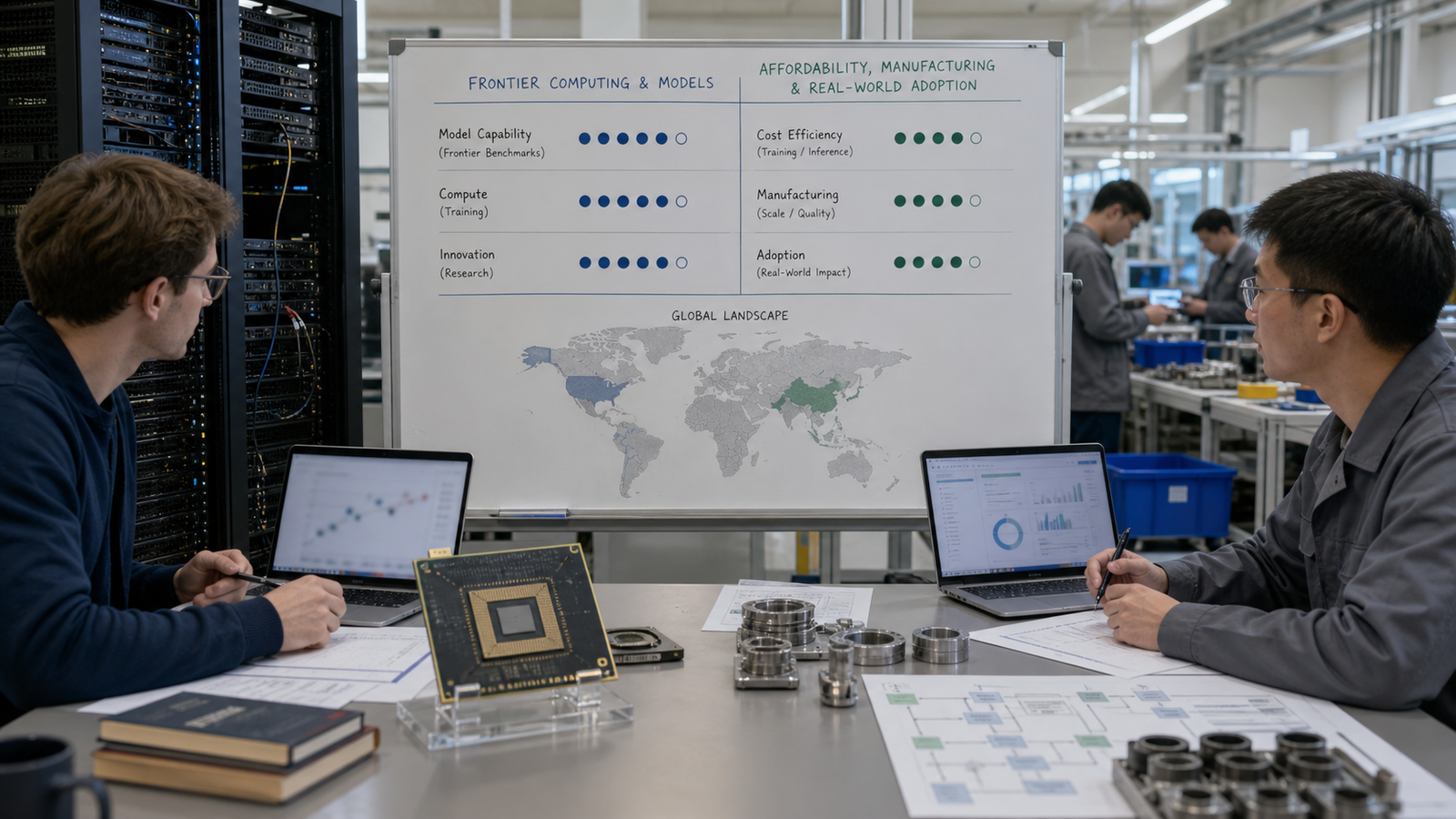
The America vs China in AI debate is often presented as a simple question: which country is winning? The more accurate answer is that the contest has several scoreboards. The United States currently has a strong advantage at the frontier of large AI models, advanced computing, and the private companies building the most powerful systems. China, however, is closing gaps quickly, competing through lower-cost models, large-scale adoption, industrial integration, and coordinated national support.
That makes the America vs China in AI race more complicated than a single benchmark or company launch. A country can lead in model performance and still struggle to spread AI through everyday businesses. Another can trail on frontier training but move faster in manufacturing, public-sector deployment, or affordable services. The Stanford 2026 AI Index and other current research show why the comparison must include models, chips, talent, investment, adoption, and the ability to convert technical progress into economic results .
This article does not treat the competition as a prediction of inevitable victory. It explains where each country appears strongest in 2026, where each faces constraints, and why the final outcome may depend less on one spectacular model than on execution over several years.
The short answer: America leads the frontier, while China is closing the distance
If “winning” means producing many of the most capable frontier models and operating at the largest computing scale, the United States remains ahead. American technology companies benefit from deep pools of private capital, access to leading AI researchers, advanced cloud infrastructure, and a broad ecosystem of chip designers, data-center operators, and software developers. A Brookings comparison of U.S. and Chinese AI strategies describes the contest as a competition across compute, models, adoption, integration, and deployment, not just a race to release a headline-making chatbot .
China’s position is stronger than a simple “second place” label suggests. Chinese companies have improved model quality, reduced costs, expanded language capabilities, and connected AI development to manufacturing, logistics, finance, education, and public services. RAND’s 2026 analysis of global LLM adoption found that U.S. models still accounted for about 93 percent of global large-language-model website visits in August 2025, but Chinese-model visits rose sharply and their global share increased from 3 percent to 13 percent in two months, driven largely by DeepSeek . Those figures measure online adoption rather than total national capability, but they show why the America vs China in AI race is becoming more competitive.

The fairest conclusion is therefore conditional. America leads at the technological frontier today. China is making meaningful gains in affordability, diffusion, and integration. The country that turns those advantages into sustained productivity, trusted products, resilient supply chains, and broad worker benefits may ultimately have the stronger position in the America vs China in AI race.
1. Frontier models remain America’s clearest advantage in the America vs China in AI race
The first scoreboard in the America vs China in AI race is the performance of advanced general-purpose models. American firms continue to benefit from large-scale training infrastructure, specialized chips, strong research teams, and venture funding that can support expensive experimentation. The frontier is not determined only by clever algorithms. It also depends on access to computing clusters, high-quality data, engineering talent, energy, and the ability to repeat training runs quickly.
This advantage does not mean every American model is better than every Chinese model. Model performance changes quickly, and different systems may be better for coding, translation, reasoning, price, or local deployment. China’s companies have shown that efficiency improvements can narrow gaps without duplicating every element of the American infrastructure model. The important point is that the United States still has more depth at the cutting edge, while China is improving the efficiency and accessibility of capable systems.
Readers should also be cautious about treating benchmark tables as permanent rankings. Benchmarks can become saturated, models can be optimized for tests, and real-world usefulness depends on reliability, integration, cost, and safety. A model that scores well in a laboratory may not be the best choice for a factory, hospital, bank, or government office. This is one reason the America vs China in AI race cannot be settled by a single leaderboard.
2. China’s cost and adoption strategy changes the America vs China in AI race
China’s most important advantage may be its ability to spread useful AI across a large industrial economy. Lower-cost models can appeal to schools, small businesses, manufacturers, and public institutions that cannot afford premium services. RAND reports that Chinese models were priced at roughly one-sixth to one-fourth the cost of U.S. rivals, although free tiers mean many everyday users do not directly experience the full price difference .
Price matters because AI leadership is partly a distribution problem. A model that is slightly less capable but inexpensive, available through local platforms, and easy to connect to existing business software may reach more users than a stronger system with higher access costs. Chinese firms also operate in a market where government planning, manufacturing capacity, and large digital platforms can reinforce one another.
The United States has enormous consumer and enterprise adoption of AI as well, especially through cloud platforms and workplace software. Its advantage is often visible in the services people use globally. China’s opportunity is to turn AI into a deeply embedded layer of industrial activity. In this part of the America vs China in AI race, deployment speed and practical affordability may matter as much as model elegance.
3. Chips and computing power are strategic foundations in the America vs China in AI race
No serious analysis of the America vs China in AI race can ignore semiconductors. Advanced models require enormous computing resources for training and inference. That gives the United States an important advantage through leading chip designers, cloud companies, software ecosystems, and partnerships with key manufacturers. It also explains why export controls and supply-chain policy have become central to the rivalry.
The Stanford Emerging Technology Review’s 2026 semiconductor assessment explains that AI demand is driving advances in memory, high-bandwidth interconnects, specialized computing, and advanced packaging . It also warns that the United States faces talent shortages in the semiconductor industry and that supply-chain diversification remains important. American leadership therefore depends on more than designing powerful chips; it depends on manufacturing capacity, packaging, energy, equipment, skilled workers, and reliable international partnerships.
China faces restrictions on access to some advanced chips and manufacturing technologies, but restrictions do not freeze its progress. They can encourage domestic substitution, efficiency research, and alternative supply chains. The Stanford assessment notes that technology containment may have short-term effects on China’s advanced computing capabilities while also encouraging a more self-reliant and decoupled technology posture .
A 2022 Georgetown CSET analysis of AI-chip access, while older than the current 2026 debate, illustrates why chip controls are difficult to enforce. It found that Chinese military procurement records included chips designed by U.S. companies and manufactured in Taiwan and South Korea, while commercial and academic channels made it difficult to identify every end user . The lesson is not that controls are useless. It is that hardware policy requires cooperation with allies, careful enforcement, and a realistic understanding of global supply chains.
4. Talent gives America depth, but China has scale in the America vs China in AI race
The America vs China in AI race is also a contest for researchers, engineers, entrepreneurs, technicians, and managers who can turn research into working products. The United States attracts global talent through universities, technology companies, research laboratories, and a large startup ecosystem. It also benefits from experienced firms that know how to operate cloud infrastructure and commercialize software at global scale.
China has a very large technical workforce, strong engineering universities, major technology companies, and national programs that encourage AI research and application. Its scale can support rapid experimentation and large deployments. The challenge is not simply the number of graduates. It is the combination of frontier research, independent innovation, access to advanced computing, international collaboration, and the freedom to turn uncertain ideas into products.
Talent policy can therefore change the balance. Immigration rules, research funding, university partnerships, education quality, and the availability of high-skilled jobs all influence who builds the next generation of systems. America’s lead is not guaranteed if it fails to educate and retain enough workers in chips, data centers, robotics, cybersecurity, and AI engineering. China’s progress is not guaranteed if restrictions limit access to crucial tools or if its research ecosystem becomes less connected to global scientific networks.
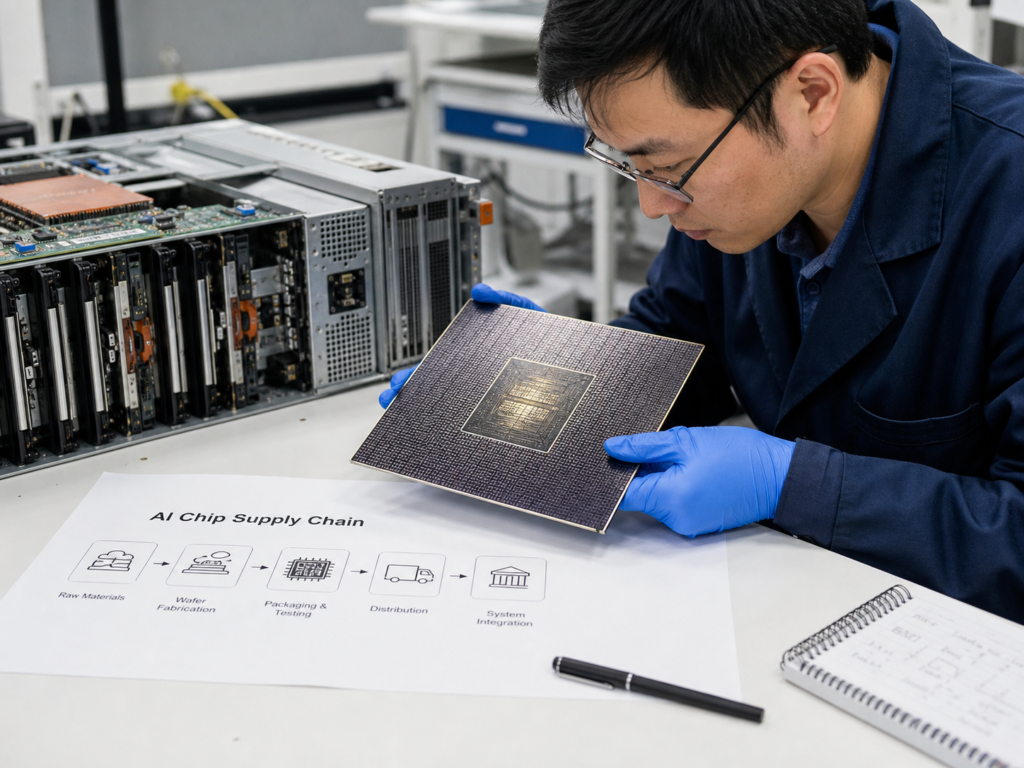
5. Industrial integration may decide who creates more value in the America vs China in AI race
The United States is strong at creating frontier platforms and software services. China is strong at connecting technology with factories, supply chains, consumer platforms, robotics, logistics, and large-scale production. That difference matters because the next stage of the America vs China in AI race will be measured by useful output, not only by model size.
A model becomes economically important when workers can use it to reduce delays, improve design, translate instructions, predict maintenance needs, manage inventory, or discover new products. China’s manufacturing base gives it many environments where AI can be tested inside physical operations. The United States has major industrial capacity too, along with strong software, finance, health, defense, and professional-services sectors. Its challenge is to spread AI benefits beyond a small group of technology companies.
Brookings argues that long-term leadership will depend on who can convert AI capability into broad economic and social gains . That is a useful standard for readers. If one country produces impressive demonstrations but the other improves productivity across millions of businesses, the practical balance may look different from the laboratory ranking.
AI + Robotics: How Intelligent Robots Are Moving from Labs to Real Life
6. Open ecosystems and government coordination shape the America vs China in AI race
The United States benefits from open research traditions, private competition, universities, venture capital, and global technology platforms. Those strengths can generate unexpected breakthroughs. They can also create fragmentation, duplication, and uncertainty about safety or public accountability. American companies may move quickly, but national coordination is not always simple.
China benefits from stronger state direction and the ability to align infrastructure, industrial policy, procurement, and national priorities. Coordination can accelerate adoption when government agencies and companies move toward the same goals. It can also create risks if information is restricted, incentives are distorted, or political priorities overshadow independent evaluation.
Neither model is automatically superior in every situation. Frontier innovation often benefits from experimentation and competition. Large-scale infrastructure and strategic supply chains may benefit from coordination. The future of the America vs China in AI race could depend on whether each country can combine its strengths without allowing its weaknesses to dominate.
7. Safety, trust, and global influence define the America vs China in AI race
A final mistake is to measure the America vs China in AI race only through speed. AI systems can produce inaccurate answers, expose sensitive information, amplify bias, or become difficult to audit when they are embedded in important institutions. Countries that want global influence must show that their systems are reliable enough for businesses, governments, and citizens to trust.
The United States has strong research communities working on evaluation, cybersecurity, privacy, and responsible deployment, but it faces disagreements over regulation and standards. China can deploy technology at scale and promote its own platforms internationally, but outside users may have concerns about data governance, censorship, transparency, or dependence on a foreign technology ecosystem. These concerns affect adoption even when a system is cheap or technically capable.
Global influence also depends on standards, cloud access, developer tools, language support, and partnerships. RAND found that Chinese models gained ground in countries with close political and economic ties to China, while U.S. models retained overwhelming global website-traffic dominance in the period studied . That suggests a divided market is possible, with different countries choosing systems based on price, political alignment, language, regulation, and trust.
What the answer means for workers, businesses, and readers
For workers, the America vs China in AI comparison is not just a geopolitical story. It affects which tools appear in workplaces, which skills employers value, how products are designed, and whether AI becomes a complement to human work or a reason to reduce headcount. Workers should watch changes in tasks rather than assume that an entire occupation will disappear overnight.
For businesses, the rivalry may create more choices and lower prices, but it may also produce fragmented standards, export restrictions, cybersecurity risks, and uncertainty about where data is processed. A company choosing an AI system will need to consider performance, cost, privacy, reliability, vendor stability, and legal requirements rather than choosing solely on national origin.
For the public, the race can bring faster medical research, better translation, more accessible education, and new productivity tools. It can also increase misinformation, surveillance concerns, labor disruption, and pressure on governments to adopt systems before they are fully tested. Understanding both sides is more useful than cheering for one country.
So, who is winning the America vs China in AI race in 2026?
The honest answer is that America is ahead in frontier capability, compute scale, and many of the companies building the most advanced general-purpose systems. China is a powerful challenger with strong engineering depth, a huge domestic market, lower-cost models, industrial scale, and an ability to integrate AI into real-world systems quickly. The America vs China in AI race is therefore not a clean victory for either side.
If the question is who leads today’s frontier, the United States has the stronger claim. If the question is who may spread AI more broadly across manufacturing, public services, and lower-cost markets, China’s position deserves serious attention in the America vs China in AI race. If the question is who will create the greatest long-term value, the result remains open.
The final winner will not be determined by one chatbot, one benchmark, or one year of investment. It will depend on chips, talent, energy, research, adoption, trust, governance, and the ability to turn AI into durable improvements for ordinary people. That is the clearest lesson from the America vs China in AI comparison in 2026, and it explains why the America vs China in AI race remains open.
Frequently Asked Questions
Is America currently ahead of China in the America vs China in AI race?
America appears to lead in frontier model performance, computing scale, private-sector investment, and global platform reach. China is advancing quickly in cost reduction, adoption, industrial integration, and domestic ecosystem development, so the lead should not be treated as permanent.
What is the biggest U.S. advantage in the America vs China in AI race?
The biggest American advantage is the depth of its frontier ecosystem. It combines advanced chip designers, cloud providers, research universities, global software firms, venture capital, and international technical talent.
What is China’s biggest advantage in the America vs China in AI race?
China’s strongest advantages are scale, manufacturing connections, lower-cost deployment, a large domestic market, and coordinated support for strategic technologies. These strengths can help it spread capable systems quickly even when it does not lead every frontier benchmark.
Are Chinese AI models cheaper than American models?
RAND reports that Chinese models were one-sixth to one-fourth the cost of U.S. rivals in the period it studied, although free tiers mean many users do not directly experience those price differences . Pricing changes quickly, so readers should check current product terms.
Do U.S. chip restrictions stop China from developing AI?
They can slow access to some advanced computing resources and raise costs, but they do not stop research or guarantee a permanent American lead. Restrictions can also encourage domestic substitution and more separate technology ecosystems.
Will the America vs China in AI race affect everyday jobs?
Yes. It can influence the price and availability of workplace tools, the skills employers request, the industries receiving investment, and the speed at which AI is integrated into offices, factories, logistics, education, and services.
Is there one clear winner in the America vs China in AI race?
Not yet. America leads on several frontier measures, while China is strong in adoption, cost, manufacturing integration, and coordinated deployment. The most useful answer is to identify which country leads on the specific dimension being measured.