
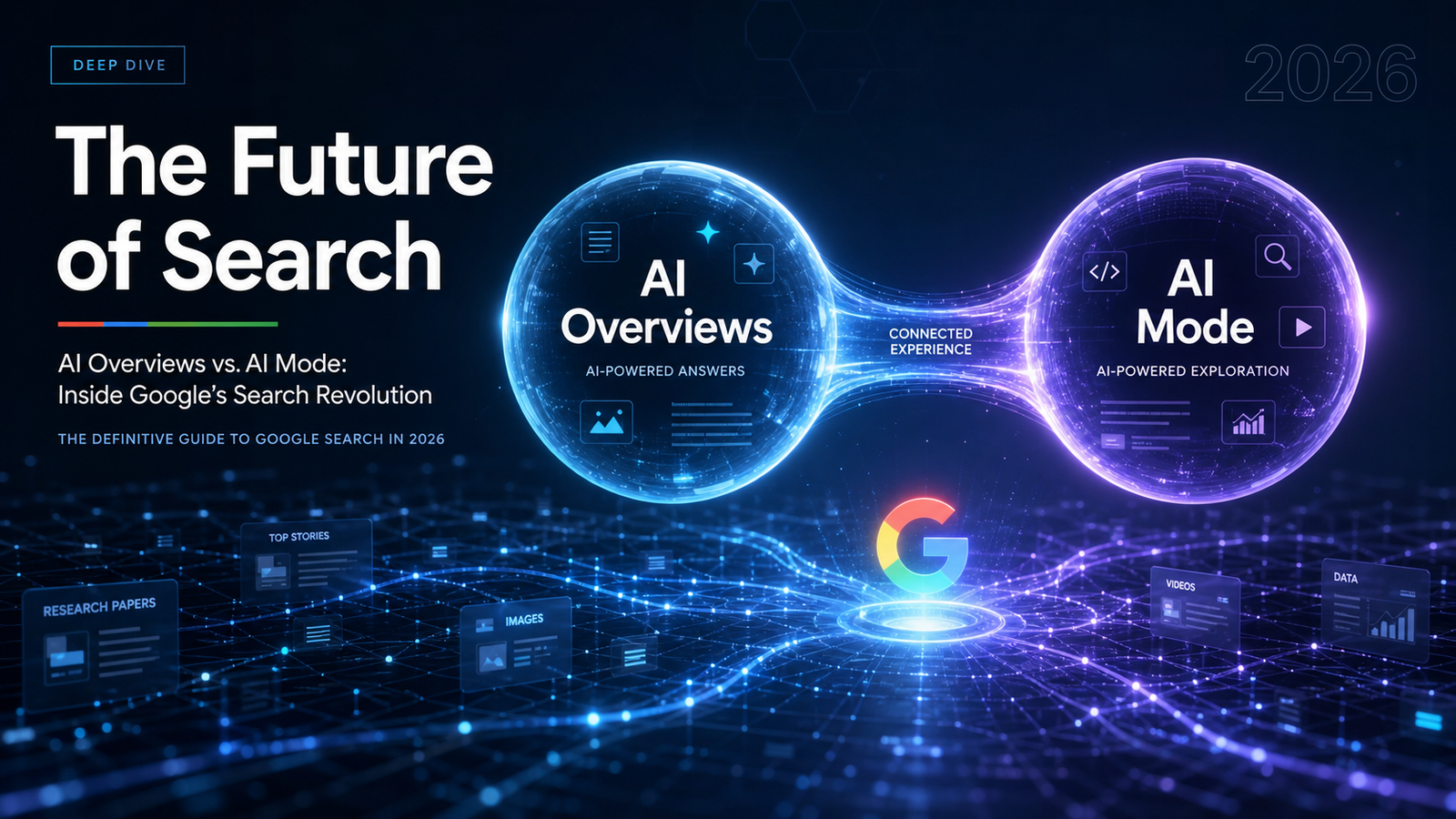
The year 2026 has marked a fundamental transformation in how the world interacts with information. For decades, the “Google Search” experience was synonymous with entering a query and receiving a list of ranked websites. Today, that experience has branched into two distinct but interconnected pathways: AI Overviews and AI Mode. While both features utilize Google’s advanced Gemini models to synthesize information, they serve vastly different purposes and cater to different user behaviors. Understanding the nuances of AI Overviews vs AI Mode is no longer just a technical curiosity; it is a vital requirement for anyone looking to navigate or optimize for the modern digital landscape.
As Google continues to integrate generative artificial intelligence into its core products, the boundary between a “search engine” and an “AI assistant” has blurred. AI Overviews provide a quick, glanceable summary of information at the top of the standard results page, while AI Mode offers a full-screen, conversational interface for deep exploration. This dual-track approach allows Google to satisfy the need for instant answers while also providing a surface for complex, multi-step tasks. In this comprehensive guide, we will explore the critical differences in AI Overviews vs AI Mode and what they mean for the future of search.
1. The Interface: Snapshot vs. Surface
The most immediate difference in the AI Overviews vs AI Mode debate is the visual interface itself. AI Overviews are designed to be an integrated part of the traditional search results page. They appear as a “snapshot” or a summary box at the very top, sitting just above the traditional organic links. This design allows users to consume a summary of the answer without ever leaving the main search environment. In the context of AI Overviews vs AI Mode, the Overview is a feature built for speed and efficiency, providing the “key info” at a glance while keeping the rest of the web just a scroll away. According to PingPrime, these snapshots are now a central part of the user experience for nearly half of all global queries.
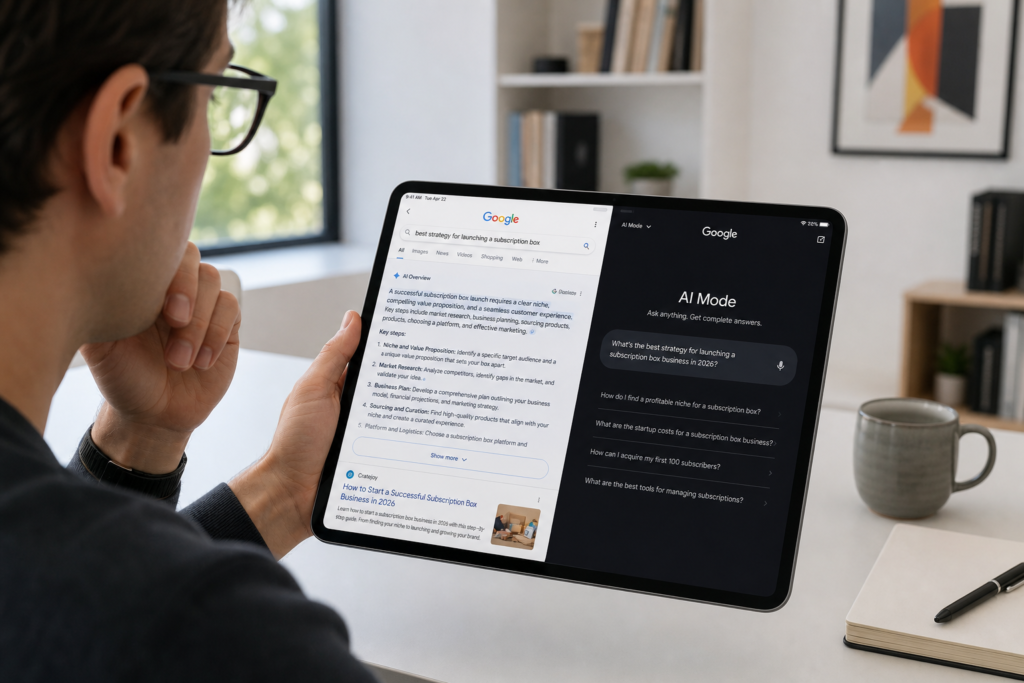
A realistic editorial photograph of a modern tech-savvy individual using a high-end tablet in a bright, minimalist home office. The tablet screen clearly shows a “split-view” comparison: on one side, a standard Google Search page with a prominent AI Overview box at the top; on the other side, the full-screen conversational AI Mode interface. The individual is looking thoughtfully at both, illustrating the choice between AI Overviews vs AI Mode in a professional 2026 setting.
2. User Intent: Quick Answers vs. Deep Exploration
When comparing AI Overviews vs AI Mode, it is essential to look at the user intent that each feature is designed to satisfy. AI Overviews are triggered primarily by informational queries where the user is looking for a fast, accurate answer to a specific question. Whether it is a recipe, a historical fact, or a summary of a current news event, the Overview is there to “take the work out of searching” by providing the most relevant details immediately. It is the digital equivalent of a quick reference guide.
AI Mode, however, is built for deep exploration and complex task management. Users typically enter AI Mode when they have a problem to solve that requires multiple steps, follow-up questions, or a synthesis of diverse perspectives. For example, planning a three-week international itinerary or researching the long-term economic impacts of a new policy are tasks better suited for AI Mode. When evaluating AI Overviews vs AI Mode, the latter allows for a conversational back-and-forth that isn’t possible in the static environment of an AI Overview. This distinction in intent is a cornerstone of Google’s dual-track AI strategy, ensuring that both quick lookups and deep research are covered.
AI Search Era: 7 Critical Ways SEO Is Changing in 2026
3. Depth and Comprehensiveness of Content
The depth of information provided is another critical area where AI Overviews vs AI Mode diverge. Because AI Overviews are snapshots, they are inherently limited in their scope. They are designed to be concise, providing just enough information to satisfy the initial query while offering links to “dig deeper” into the source material. An Overview might summarize the top three benefits of a new technology, but it rarely dives into the technical minutiae or the conflicting expert opinions surrounding it.
AI Mode is where that depth truly lives. Because it is a conversational surface, it can provide significantly more comprehensive responses. It can generate long-form reports, compare multiple data sets in detail, and even perform complex reasoning tasks. According to Semrush, AI Mode changes how content is discovered by moving beyond the “10 blue links” into a world of AI-generated synthesis. This comprehensive nature makes AI Mode the preferred tool for researchers, professionals, and anyone who needs a complete picture of a topic rather than just a summary. In the ongoing evolution of AI Overviews vs AI Mode, the depth of the conversational surface is what sets it apart as a true productivity partner.

4. Contextual Persistence and Follow-up Queries
A major functional difference in the AI Overviews vs AI Mode experience is how context is handled. In a traditional search with an AI Overview, each query is largely treated as a standalone event. While you can ask a follow-up question, it often feels like starting a new search. The Overview updates based on the new query, but the previous context is not always maintained in a way that feels like a continuous conversation. It is a “stateless” experience optimized for individual answers. This is a primary functional divide in AI Overviews vs AI Mode, where the former is about the immediate result and the latter is about the ongoing journey.
AI Mode, by definition, is built on contextual persistence. It remembers the previous parts of the conversation, allowing users to refer back to earlier points without repeating themselves. This “conversational memory” is what allows for a true back-and-forth dialogue. As Google’s official blog notes, users can easily flow from an initial AI Overview into a full AI Mode conversation, with their context being seamlessly carried over. This persistence is vital for complex problem-solving where each answer builds upon the last.
5. Source Citation and Visibility for Creators
For content creators and businesses, the most concerning part of the AI Overviews vs AI Mode comparison is how sources are cited. AI Overviews are very prominent and include clear links to the websites used to generate the summary. These links are often placed alongside the text or in a dedicated “source carousel.” While this can drive “zero-click” behavior, it also provides a high-visibility opportunity for authoritative sites to be cited as the primary source of truth in the main search results.
In AI Mode, citations are handled differently. Because the responses are longer and more synthesized, the citations are often woven into the conversational flow or provided at the end of a long response. Visibility in AI Mode is less about “ranking” in a list and more about being the “expert” that the AI relies on for its deep dives. Adobe has pointed out that visibility in 2026 depends heavily on whether a brand is cited within these AI-generated responses. Being a trusted source in AI Mode requires a high level of topical authority and E-E-A-T. This citation challenge is a key factor for creators to consider when optimizing for AI Overviews vs AI Mode in 2026.
6. The Role of Gemini: Integration vs. Interaction
While both features are powered by Gemini, the way the AI model is presented differs in the AI Overviews vs AI Mode dynamic. In AI Overviews, the AI is largely invisible; it is a tool that enhances the search results. The user is still “searching Google.” The AI is a silent partner that does the heavy lifting of summarization in the background. It is an “integration” of AI into an existing product to make it more efficient for the end user. When we look at AI Overviews vs AI Mode, we see a clear path from a smart search engine to a fully interactive AI assistant.
AI Mode, however, is a direct “interaction” with the AI itself. The interface often features the Gemini branding more prominently, and the tone of the responses is more conversational and personable. It feels like a collaboration between the user and the machine. This distinction is important for user trust and branding. AI Overviews are about the “search,” while AI Mode is about the “assistant.” This shift in perspective influences how users perceive the accuracy and reliability of the information they are receiving.
7. Impact on “Zero-Click” Search Behavior
The final critical difference in AI Overviews vs AI Mode is their impact on the broader search ecosystem, particularly “zero-click” searches. AI Overviews are the primary drivers of zero-click behavior on the standard SERP. By providing the answer directly on the page, they satisfy the user’s need immediately, often removing the reason to click through to a website. This has forced a massive shift in SEO strategy toward “cite-ability” and brand recognition rather than just traffic volume.
AI Mode, while also a zero-click environment in the traditional sense, creates a different kind of engagement. Because users are in a deep conversational flow, they may eventually click through to sources to verify details or explore a specific sub-topic in even more depth. However, the “click” happens much later in the journey. According to Search Central, understanding how these features work from a site owner’s perspective is vital for adapting content to remain visible. The goal in the AI search era is to be the source that the user eventually seeks out after the AI has provided the initial context. Balancing your presence in AI Overviews vs AI Mode is the only way to ensure long-term visibility.
The Future: A Seamless AI Search Experience
As we move further into 2026, the distinction between AI Overviews vs AI Mode is becoming less about separate features and more about a single, fluid experience. Google is increasingly allowing users to “pivot” from a quick Overview into a deep AI Mode conversation with a single tap. This “seamless AI search” is the ultimate goal, where the engine automatically adjusts its interface and depth based on the evolving needs of the user. For marketers, this means that content must be optimized for both the quick summary and the deep dive.

The most successful search strategies in this new era will be those that embrace the dual nature of AI Overviews vs AI Mode. You must provide the “bite-sized” facts that AI Overviews love to cite, while also building the “deep-dish” topical authority that AI Mode requires for its comprehensive reports. By understanding the critical differences in how these features operate, you can position your brand to be visible at every stage of the user’s journey, from the first quick question to the final complex decision.
Frequently Asked Questions
What is the main difference between AI Overviews and AI Mode?
The main difference in AI Overviews vs AI Mode is the interface and intent. AI Overviews are brief snapshots at the top of a standard search page for quick answers, while AI Mode is a full-screen conversational interface for deep exploration and complex tasks. Understanding AI Overviews vs AI Mode is critical for both users and content creators.
Is AI Mode the same as Gemini?
AI Mode is a specific interface within Google Search that is powered by Gemini. While they are related, AI Mode is the “surface” you interact with in search, whereas Gemini is the underlying AI model that generates the responses.
How do I get my website cited in AI Overviews?
To be cited in an AI Overview, your content should be clear, authoritative, and well-structured. Focus on providing direct answers to common questions and using structured data (Schema) to help Google’s AI understand your content.
Does AI Mode drive traffic to websites?
In the context of AI Overviews vs AI Mode, AI Mode can drive traffic, but usually later in the user’s journey. Because it is a deep conversational tool, users may click on cited sources to verify specific facts or read more detailed analysis after the AI has provided a summary.
Why is Google merging AI Overviews and AI Mode?
Google is merging them to create a more “seamless” experience. This allows a user to start with a quick question (Overview) and easily flow into a deeper conversation (AI Mode) without losing their context or having to start a new search.
Will AI Overviews replace traditional search results?
AI Overviews are not intended to replace traditional results but to enhance them. They provide a summary of the most relevant information, while the traditional “blue links” remain available for users who want to explore multiple different sources.
What is “zero-click” search?
In the AI Overviews vs AI Mode ecosystem, a zero-click search is a query that is satisfied directly on the search results page without the user needing to click through to any external website. AI Overviews are a major contributor to this trend in the AI search era.