

Have you ever watched one short video about fitness and suddenly received a week of workout clips, supplement promotions, and meal-preparation tips? Or perhaps you searched for a phone once and then noticed similar products appearing across several apps. It can feel as if your phone is reading your mind. In reality, social media algorithms are continuously making predictions about what you may find useful, entertaining, or worth your attention.
The word “algorithm” can make the process sound mysterious. It is not one secret formula that decides everything. Each platform uses several ranking and recommendation systems. These systems collect possible posts or videos, examine signals, predict what might be relevant to you, and then arrange the available content in an order. The result is a personalized feed that changes as your behavior changes, which is why social media algorithms can make the same platform feel different from one person to another.

This personalization can be helpful. It can introduce you to a talented creator, explain a difficult topic, or help you discover a community that matches your interests. Understanding social media algorithms makes these recommendations easier to question and control. However, it can also narrow your view, reward emotionally intense content, and make it difficult to tell the difference between popularity and reliability. Understanding how social media algorithms work gives you more control over what you see and how you respond to it.
What Are Social Media Algorithms?
A social media algorithm is a set of computational rules and machine-learning models used to select, rank, recommend, or filter content. When you open an app, there may be thousands of possible posts, Stories, Reels, videos, comments, or advertisements available. Showing all of them in chronological order would not create the experience most platforms want. Instead, the system tries to predict which items are most likely to matter to you.
A typical recommendation process has four stages. First, the platform gathers a pool of eligible content. Second, it studies signals connected to your activity, the content, the account, and your relationships. Third, it predicts actions or outcomes, such as whether you may watch, like, save, share, comment, or continue scrolling. Finally, it ranks the candidates and displays the highest-scoring items first. That repeating cycle is the basic operating pattern behind social media algorithms.
This does not mean the system knows exactly what you think. It makes probability-based guesses. A prediction can be wrong, especially when your interests change, when someone else uses your account, or when a platform has limited information about you. It is more accurate to think of your feed as a constantly updated prediction rather than a perfect reflection of your identity.
1. Your Activity Teaches the Feed What You Like
The most direct way social media algorithms learn about your interests is through your activity. In other words, your everyday choices become training signals for social media algorithms. Likes, comments, shares, saves, follows, searches, profile visits, and video views can all act as signals. On some platforms, watching a video until the end or immediately skipping it can also influence future recommendations.
Instagram’s official says that Feed ranking considers activity such as posts you have liked, shared, saved, or commented on. It also considers information about the post, the person who posted it, and your history of interacting with that person. TikTok’s official similarly describes user interactions, content information, and user information as major categories in its recommendation systems.
Not every action carries the same meaning. A like may indicate mild approval, while saving a post may suggest that you want to return to it. A share may signal that the content is valuable enough to send to another person. Repeatedly watching similar videos can make the system more confident that the topic interests you.
The important lesson is that passive behavior can influence the feed too. Social media algorithms can learn from what you do not actively label with a Like. You do not need to press Like for your behavior to become informative. The videos you finish, skip, replay, search for, or watch for a long time may all help shape future recommendations.
2. Watch Time and Attention Influence Recommendations
Many platforms try to estimate whether content holds your attention. This attention-based model is central to how social media algorithms decide which posts deserve another opportunity in your feed. A longer viewing session can suggest that a video is relevant or entertaining, although watch time alone does not prove that the content is valuable. You may watch a video because it is confusing, upsetting, or difficult to look away from.
TikTok’s official guidance lists full watches, skips, and viewing behavior among the signals that can influence the For You feed. It also notes that user interactions, which may include viewing time, often carry more weight for many users than other factors. Meta’s describes signals such as how long people spend viewing photos, videos, and comments.
This is one reason short-form platforms can feel highly personalized. Social media algorithms can change the next group of recommendations after only a few viewing decisions. The system can receive feedback almost immediately. If you watch three videos about a subject, it may test more content from that subject. If you skip those videos quickly, it may reduce similar recommendations.
For users, this means a few minutes of deliberate behavior can reshape a feed. If you want more educational content, watch useful videos for longer, save practical posts, follow reliable creators, and search for related subjects. If you do not want a topic to dominate your feed, avoid repeatedly opening or rewatching it and use the platform’s “Not interested” option when available.
3. Content Information Helps Platforms Classify Posts
The content itself also gives recommendation systems information. Social media algorithms use these details to understand what a post is about before matching it with possible viewers. Platforms can analyze captions, hashtags, audio, topics, language, location, format, and visual or textual features. These signals help a system determine whether a post belongs to technology, sport, travel, education, entertainment, or another category.
TikTok’s lists audio, hashtags, view counts, the country where content was published, and how well content matches a search query among possible content signals. Instagram’s considers information about the post, including how quickly people interact with it and when it was published. Meta’s says Facebook Feed systems examine post type, media, topic, visibility, and other content characteristics.
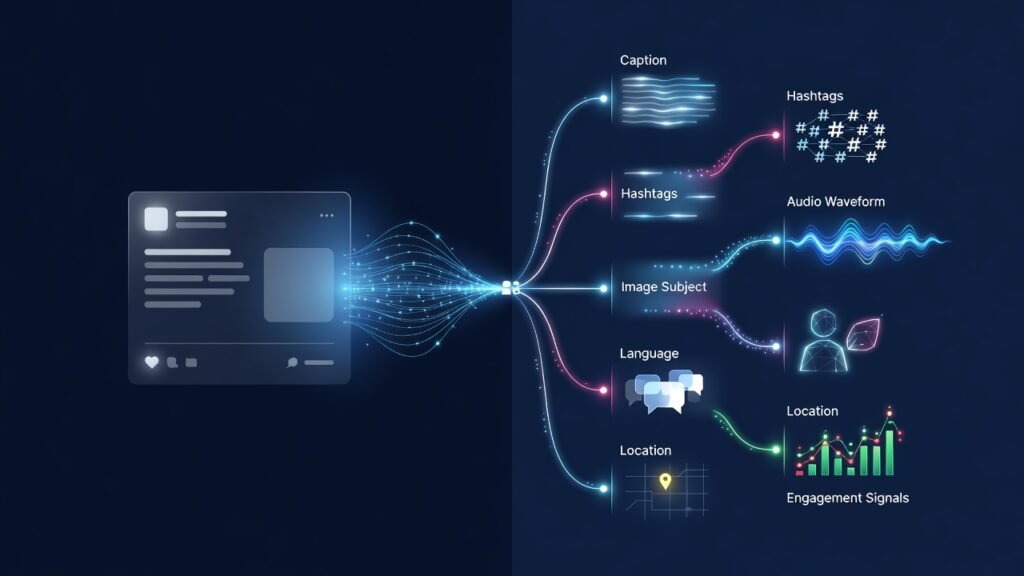
This classification is useful because it helps platforms connect a new post with people who have shown interest in similar topics. For creators, understanding social media algorithms means understanding both the topic and the audience response. It also explains why clear descriptions, relevant captions, and accurate topic labels can help content reach the right audience. However, adding dozens of unrelated hashtags does not guarantee distribution. If the actual content does not satisfy viewers, the initial exposure may not lead to sustained reach.
Content classification also creates risks. A system may misunderstand sarcasm, miss cultural context, or associate a legitimate educational discussion with a sensitive subject. Automated systems are powerful, but they are not perfect judges of meaning.
4. Relationships and Previous Interactions Shape What Appears
Your relationship with an account can influence ranking. This is another reason social media algorithms may prioritize familiar people and creators. Platforms may consider whether you follow someone, how often you view that person’s content, whether you exchange messages, or whether you regularly comment on one another’s posts. This helps explain why content from a close friend may appear more prominently than a post from an account you rarely interact with.
Instagram’s says Stories use viewing history, engagement history, and closeness as important signals. Its Feed system also considers your interaction history with the person who posted. These signals are not necessarily a judgment of the creator’s overall quality. They are predictions about your personal interest in seeing that account.
Relationship signals can make social media feel convenient. They also show why social media algorithms may rank a familiar account above a newer account with equally useful content. You are more likely to see a family update, a message from a colleague, or a creator you follow closely. The downside is that your feed can become repetitive. If you interact with a narrow group of accounts, the system may keep offering similar perspectives.
A simple way to broaden your feed is to follow several trustworthy sources with different viewpoints and areas of expertise. You can also use a platform’s Following, Favorites, or chronological feed when available. These options may not remove personalization entirely, but they can make the source of your content clearer.
5. Popularity Is a Signal, Not a Guarantee of Truth
High engagement can help a post receive more attention. If many people like, comment on, save, or share something quickly, a platform may interpret that activity as evidence that the post is interesting. This can create a feedback loop: more distribution leads to more engagement, which leads to more distribution.
However, popularity does not prove accuracy. Social media algorithms can distribute a claim widely without independently confirming that it is true. A false claim can be emotionally appealing, easy to share, or deliberately designed to provoke outrage. A careful explanation may receive fewer reactions even when it is more reliable. This is one of the most important limitations of social media algorithms: they often optimize for predicted relevance, satisfaction, or interaction, not for independent truth in every post.
Meta says its ranking systems use predictions about whether content will be valuable, spark conversation, or be problematic. It also says certain content may receive reduced distribution when it violates policies or is rated false or partially false by independent fact-checking partners. These safeguards are important, but they do not turn a feed into a perfect news source.
Before sharing a surprising claim, check the original source, publication date, supporting evidence, and coverage from reliable outlets. For topics involving health, public safety, elections, finance, or breaking events, do not rely on a viral post alone.
The Dark Side of AI: Deepfakes, Misinformation, and What You Can Do
6. Your Device, Location, and Settings Can Affect Recommendations
Recommendation systems may also use information about how and where you access a platform. Examples can include language preference, location, time zone, device type, operating system, and activity patterns. These signals help platforms provide content that is locally relevant or technically suitable.
TikTok lists device settings, language, location, time zone, date, and device type as possible user-information signals. Meta’s Facebook documentation describes account, device, location-related, language, time, frequency, and duration signals in its ranking explanation.
This does not mean that every platform uses every possible signal in the same way, or that a single setting controls your entire feed. Social media algorithms are personalized systems, not a single switch that users can turn on or off. Recommendation systems are complex and change over time. Privacy settings, regional laws, product experiments, and account choices can also affect what information a platform uses.
You should review app permissions and privacy settings periodically. Remove access that an app does not need, understand whether contact syncing is enabled, and check the platform’s activity controls. Reducing unnecessary data sharing may not eliminate personalization, but it can limit some forms of tracking and make your choices more deliberate.
7. Safety, Quality, and Diversity Rules Filter the Feed
Algorithms do not only rank content by predicted interest. Social media algorithms also use eligibility, safety, quality, and integrity rules before content can be widely recommended. Some content may be removed entirely. Other content may remain available but receive fewer recommendations because it is considered unsuitable for broad distribution.
explains that it may limit the recommendation of content that could create a negative experience when shown repeatedly, even when that content is not removed from the platform. Instagram’s uses eligible public content and provides controls for sensitive content, hidden posts, and posts marked “Not interested.” YouTube’s also describes information panels that provide additional context around certain events, topics, publishers, and altered or synthetic media.
These systems can protect users, but they are not always transparent or consistent. In practice, social media algorithms balance relevance, safety, quality, and business priorities at the same time. A post may have low reach because it is ineligible for recommendations, because it does not match a user’s interests, or because it simply competes with a large amount of other content. Creators should avoid assuming that every change in reach is a penalty.
For users, quality and diversity controls are valuable. Use them when your feed becomes repetitive, distressing, or dominated by low-quality material. Curate intentionally rather than allowing the first few recommendations to define your entire information environment.

How to Take Back Control of Your Social Media Feed
You cannot directly see every calculation made by social media algorithms, but you can send clearer signals and use the controls provided by each platform. The goal is not to defeat social media algorithms; it is to make your preferences clearer and your information diet wider.
Follow a wider range of reliable sources
Follow creators, publications, educators, and organizations that offer different subjects and perspectives. A broader set of sources reduces the chance that one narrow interest will dominate your recommendations.
Use “Not interested” instead of only scrolling away
Scrolling past a post may provide a weak or ambiguous signal. When a platform offers “Not interested,” use it for content you genuinely do not want to see. TikTok, Facebook, and Instagram all describe versions of this control.
Search deliberately and verify important information
Your searches influence future recommendations. Search for primary documents, original reporting, and multiple viewpoints rather than relying only on viral summaries. You can also open the source outside the social platform before sharing a claim.
Review watch, search, and activity history
The explains that users can pause, edit, or delete search and watch history. Other platforms provide their own activity controls. Review this information when your recommendations seem inaccurate or when another person has used your account.
Use chronological or Following feeds where available
A chronological feed can help you see recent posts from accounts you intentionally follow instead of a purely predictive selection. Instagram’s Following feed and Facebook’s Feeds tab are examples of controls designed to provide a more direct view of connected content.
Slow down before reacting
If a post makes you instantly angry or frightened, pause before liking, commenting, or sharing. Strong reactions may tell the system that the topic deserves more of your attention. Read the full caption, check the date, and look for supporting evidence first.
Social Media Algorithms and Privacy
Personalization requires information. Learning how social media algorithms use that information helps you make more thoughtful privacy choices. The more a platform knows about your behavior, relationships, preferences, device, and location, the more signals it may have for making recommendations. That does not automatically mean your data is being misused, but it does mean you should understand the exchange: convenience and relevance in return for some level of data collection and prediction.
Read the privacy settings for the platforms you use. This is especially important because social media algorithms can use account, device, and activity signals in different ways. Turn off unnecessary permissions, review ad preferences, limit contact uploads when possible, and use separate browser or device settings if you want to reduce cross-service tracking. Do not assume that deleting one post removes every record of your activity; data practices differ by platform and region.
AI and Privacy: What Happens to Your Data When You Use AI Tools?
The Difference Between Personalization and Manipulation
Personalization means a platform adapts content to your predicted interests. Manipulation is a broader concern about how design, incentives, and repeated exposure may influence your choices. The two ideas can overlap, but they are not identical.
A feed may personalize your experience without trying to persuade you about a political issue. At the same time, an engagement-focused design can make emotionally intense material unusually visible. The safest approach is not to assume that every recommendation is malicious or neutral. Social media algorithms reflect predictions and platform objectives, so you should keep your own judgment involved. Treat it as selected content shaped by commercial goals, technical systems, and your previous behavior.
You remain responsible for the final decision to believe, share, buy, or act. The more important the decision, the more you should step outside the feed and consult independent sources.
Frequently Asked Questions
Do social media algorithms listen to everything I say?
A recommendation may feel connected to a private conversation, but that feeling alone does not prove that an app used your microphone for advertising or ranking. Recommendations can result from searches, browsing activity, shared networks, location, contacts, similar users, and your previous interactions. Review app permissions and privacy policies rather than relying on assumptions.
Why do I keep seeing the same type of content?
Repeated viewing, likes, follows, searches, saves, shares, and comments can tell social media algorithms that you are interested in a topic. A narrow set of followed accounts can have the same effect. Use “Not interested,” follow new reliable sources, and search for different subjects to broaden your feed.
Are social media algorithms the same on every platform?
No. Each platform designs social media algorithms around its own products, goals, and user controls. Instagram, TikTok, Facebook, YouTube, and other platforms use different systems, goals, surfaces, and signals. Even one platform may use different ranking methods for its home feed, Stories, search, short videos, and notifications.
Does more engagement always mean better reach?
No. Engagement can be one signal, but recommendation systems also consider user interest, content information, relationships, eligibility, quality, and predicted value. A post may receive attention for negative reasons and still be unsuitable for broad recommendation.
Can I turn off social media algorithms completely?
Usually, you cannot remove every ranking or recommendation system while using a modern platform. However, many services provide controls such as chronological feeds, Following views, topic management, activity-history settings, sensitive-content controls, keyword filters, and “Not interested.” The available options vary by platform, account, and region.
Final Thoughts
Social media algorithms decide what you see by combining your activity, the content itself, account and relationship signals, technical information, safety rules, and predictions about what may keep you interested. They are not a single universal formula, and they do not understand your values perfectly. They are systems that make changing probability-based guesses.
The best response is not to panic or accept every recommendation without question. Once you understand social media algorithms, you can use them more deliberately instead of letting them set every topic in your feed. Use the controls available to you, diversify your sources, protect your privacy, and verify important information beyond the feed. Once you understand the system, you can make your social media experience more useful, more balanced, and more intentional.