
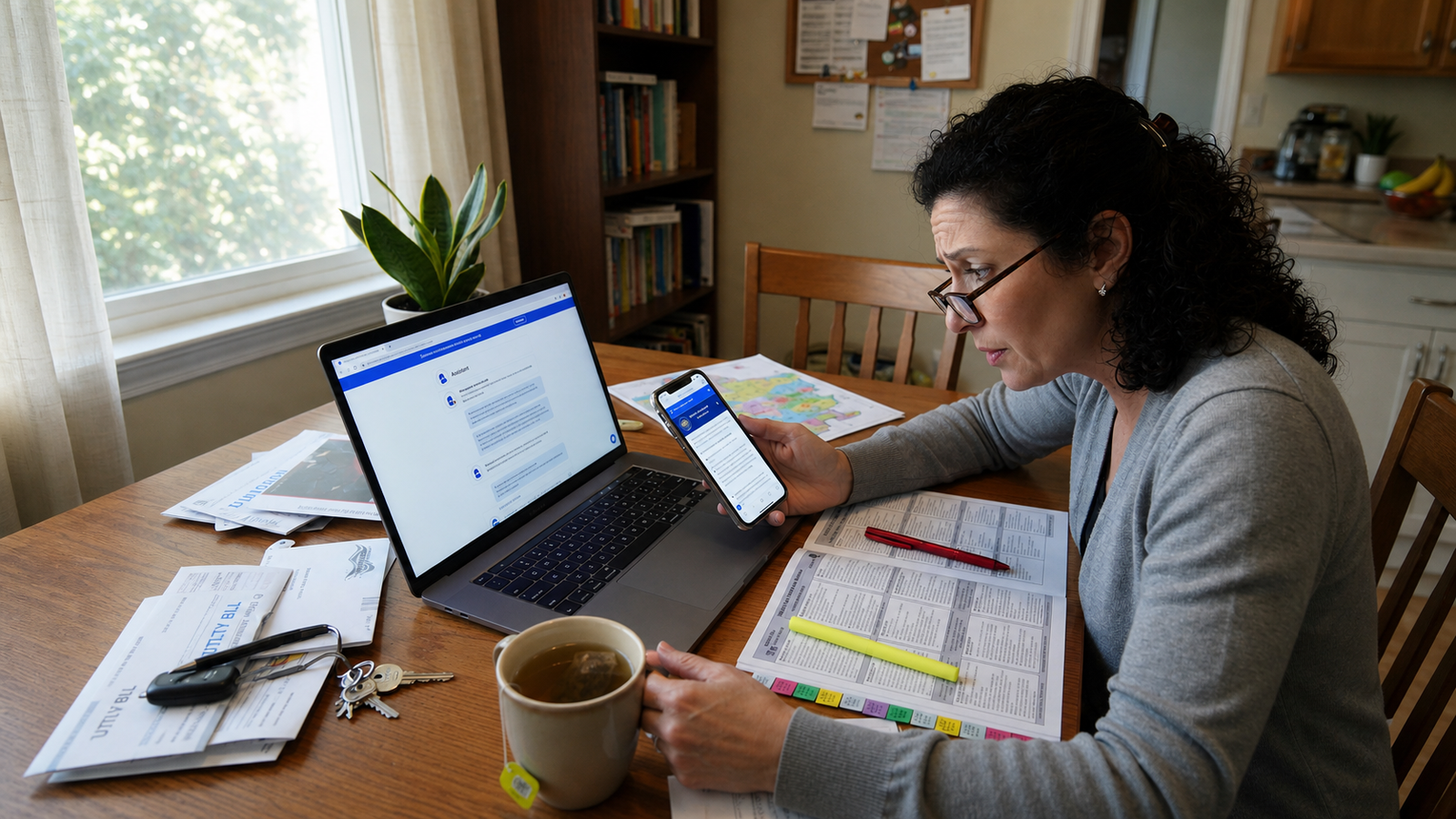
If you ask an AI chatbot when to register, where to vote, who is on the ballot, or how to request a mail ballot, you may receive an answer within seconds. That convenience is changing how people search for civic information. Yet AI election information should be treated as a starting point, not as the final authority. A response can sound polished, current, and confident while still being incomplete, out of date, or wrong for your jurisdiction.
The honest answer to this article’s title is neither an automatic yes nor an automatic no. AI election information can help explain political terms, summarize a long policy document, translate a voting instruction, or suggest questions to ask an election office. It can also invent details, miss a recent change, confuse one state with another, or provide a partial answer that leaves out an important requirement. The right question is not whether a chatbot feels trustworthy. The right question is whether its answer can be independently verified.
The U.S. Election Assistance Commission warns that AI-generated information may appear plausible while being inaccurate, especially when voters need precise dates, hours, locations, and procedures. Its AI and elections guidance recommends directing voters toward verifiable official sources rather than relying on an AI response alone . The commission puts the risk plainly:
“AI-generated information may seem plausible, but it is often inaccurate.” — U.S. Election Assistance Commission
That distinction matters because election information is local. Rules can differ between states, counties, municipalities, and election types.
This guide offers seven practical questions to ask before trusting AI election information. It is written for ordinary readers, not cybersecurity specialists. The goal is not to make you afraid of useful technology. It is to help you use it with enough skepticism to protect your time, your vote, and your understanding of a fast-moving political environment.
The short answer: use AI election information as a guide, not as your election office
AI is most useful when it helps you orient yourself. You can ask it to explain the difference between a primary and a general election, translate a public notice, summarize a candidate’s published platform, or create a checklist of questions. These are tasks where a conversational tool may save time and make complicated language easier to understand.
It is much riskier to treat a chatbot as the final source for a deadline, polling place, registration status, ballot eligibility, candidate filing, or election result. These details can change. They can also depend on your address, your local election authority, your voting method, and the date on which you ask. A response that is correct for one person may be unusable for another.
| AI can help you | Verify elsewhere before acting |
| Understand unfamiliar election terms | Registration deadlines and eligibility |
| Summarize a document you provide | Polling locations, opening hours, and access rules |
| Translate or simplify official instructions | Mail-ballot requirements and submission deadlines |
| Compare questions you want to ask candidates | Candidate lists and district-specific races |
| Find possible sources to investigate | Election results, recounts, and official certifications |
Think of the chatbot as an assistant who can help you organize AI election information but cannot prove that the information is current. The safer workflow is simple: ask, inspect the sources, open the official page, confirm the date and jurisdiction, and contact the election office if anything remains unclear.
Seven Critical Questions About AI Election Information
Question One: Is This AI Election Information Stable or Changing?
Some political questions are relatively stable. You can ask what a referendum is, how a legislature differs from a court, or what people mean by proportional representation. A clear answer can help you build background knowledge, although you should still check the explanation if the distinction matters for a major decision.
Other questions are time-sensitive. When is the registration deadline? Is early voting available this weekend? Which candidates qualified for the ballot? Has the polling location moved? These answers can change as election offices update their schedules, courts issue decisions, or candidates enter and leave a race. The more local and time-sensitive the question, the less comfortable you should be relying on AI election information without verification. This is the first boundary every reader should remember.
Ask the chatbot to identify the date and jurisdiction it is using for the AI election information. If it cannot state both clearly, treat the answer as incomplete. Then open your state or local election office’s website directly. CISA explains that election infrastructure includes registration systems, voting systems, polling places, counting, auditing, reporting, and certification. Its election-security information helps show why official election systems and offices are the proper authorities for operational details .
A useful rule is to match the source to the responsibility. An official election office administers the deadline it publishes. A chatbot does not. That does not make AI useless; it tells you where the final check belongs.
Question Two: Does the AI Election Information Show Its Sources Clearly?
A trustworthy-looking paragraph of AI election information is not the same as a sourced paragraph. Ask the AI system to provide links for each important claim, not merely a general list of websites at the end. Then open those links yourself. Check whether they actually support the wording in the answer, whether the page is official, and whether the page is current.
Be cautious when a chatbot mentions a source without giving a working link, cites a page that does not contain the claimed information, or sends you to an unofficial blog for a jurisdiction-specific rule. A source can also be real but irrelevant. A national election explainer may not answer the question of what your county requires for a mail ballot.
A 2026 States United study tested how leading AI platforms answered common voter questions. The study reported that the systems improved in factual accuracy over time but were still incomplete substitutes for official election information and inconsistently directed users to official state websites . Its study of AI platforms and voter questions is useful because it separates accuracy from adequacy. An answer may contain no obvious false sentence and still fail to give a voter everything needed to participate.

If an answer matters, ask for the official election authority, the publication date, and the exact page where the claim appears. These three checks are more valuable than a confident tone when you are evaluating AI election information.
Question Three: Is the AI Election Information Specific to Your Location?
AI systems often write as if election rules are universal. They are not. Registration, identification, early voting, mail voting, accessibility, ballot collection, and polling-place rules can differ across jurisdictions. Even within one country, the correct answer may depend on your state, county, city, district, or residential address.
Never assume that AI election information written for a national audience applies locally. Give the system the relevant jurisdiction only when you are comfortable doing so, and do not share sensitive personal information such as a full identification number, login credential, or private document. More importantly, use the chatbot’s answer to find the name of the correct election authority, then visit that authority’s official website yourself.
Location questions in AI election information are especially vulnerable to small errors. A chatbot might mention a polling place from a previous election, confuse a county with a neighboring county, or provide a general office address instead of your assigned location. The mistake may look minor until you arrive at the wrong building or miss a closing time.

When the question involves where you vote or how you register, official election information should outrank AI election information every time. The chatbot can help you phrase the question. It should not be the final decision-maker.
Question Four: Could AI Election Information Be Incomplete Even if It Is Correct?
People often think of misinformation as a completely false statement. In practice, incompleteness can be just as harmful. “You can vote by mail” may be technically true but inadequate if the answer leaves out an application deadline, witness requirement, identification rule, signature instruction, or return deadline.
The same problem appears in candidate questions about AI election information. A chatbot may name several prominent candidates while omitting less visible candidates, independent candidates, local races, or a recent filing. It may summarize a platform without mentioning a major change. It may describe a ballot measure without explaining that the wording differs between a headline and the official ballot text.
This is why a verification process should ask more than “Is this sentence true?” Ask whether the answer includes the details needed to act. Does it tell you what to do next? Does it link to the responsible office? Does it mention exceptions? Does it explain when the information was last checked?
The answer is more useful when the system acknowledges uncertainty and points you toward a primary source. An answer that says “check your official state election website because rules vary” may feel less satisfying than a definitive paragraph, but it is often more responsible.
Question Five: Does AI Election Information Separate Facts From Interpretation?
Political questions often combine several layers. One layer is a factual claim, such as what a bill says or how a vote was recorded. Another is a prediction about what the policy might do. A third is an opinion about whether the result would be good or bad. AI can blur these layers by presenting an interpretation in the same smooth voice as a verified fact.
Ask the system to separate the AI election information into “what is documented,” “what is disputed,” and “what is an interpretation.” Request links to the original bill, official vote record, court opinion, agency report, candidate platform, or other primary material. Then compare the summary with the source rather than accepting the summary as a substitute for reading.
This approach is particularly important for breaking political news. Early reports may be incomplete, official statements may change, and social-media posts may circulate before the underlying document is available. AI election information can help you organize the questions, but it cannot eliminate the uncertainty of an event that is still developing.
Question Six: Could AI Election Information Be Biased or Confidently Wrong?
AI systems are trained and configured by people, connected to changing data sources, and shaped by product decisions. They can reproduce errors from their sources, overemphasize material that is widely repeated, misunderstand a question, or produce a polished answer unsupported by evidence. They may also respond differently when the wording of a prompt changes.
That does not mean every piece of AI election information is deliberately biased. It means you should not confuse fluency with neutrality. Ask the same factual question in more than one way, request the strongest evidence on competing interpretations, and check whether the cited material includes a primary source. If the answer changes dramatically without a clear reason, pause before relying on it.
Generated images, audio, and video create another problem for AI election information. A clip of a politician, election official, or journalist may look convincing while being altered or fabricated. The absence of obvious visual defects does not prove authenticity. Look for the original upload, reputable reporting, official statements, and context about when and where the material was recorded. OpenAI’s 2026 election safeguards overview describes provenance tools, source links, and policies intended to reduce misuse, but it also acknowledges that provenance tools are not a complete solution .
Question Seven: Am I Using AI Election Information or Outsourcing My Judgment?
AI election information is most helpful when it strengthens your own questions. It becomes risky when it replaces the habit of checking. Ask it to summarize an official document you have already opened. Ask it to identify unfamiliar terms. Ask it to show which parts of an answer are uncertain. Ask for a comparison table that you can verify against candidate platforms.
Do not ask a chatbot to decide who deserves your vote, tell you what you must believe, or produce a political conclusion that you will share without reading the evidence. A system may generate a persuasive argument for several sides, but persuasion is not proof. Your responsibility is to examine the claims, the sources, the assumptions, and the interests involved.
This is also where your earlier article How Election Campaigns Are Changing in the Age of Social Media can provide useful context. Campaigns, platforms, and political organizations have long tried to shape attention. AI adds speed and scale, but it does not remove the need for civic judgment. A balanced analysis of AI and election information also shows why chatbots may push back on some conspiracy theories while still making factual mistakes .
A Safer Five-Step Workflow for Using AI Election Information
Start by asking a narrow question rather than a vague one when you use AI election information. “What is the registration deadline in my state for the November 2026 general election?” is easier to verify than “Tell me everything about voting.” Do not include unnecessary private information.
Next, ask the system to state its sources, date, and jurisdiction. If the answer is missing any of these, treat it as a research lead rather than a reliable instruction. Open the links and inspect the original pages.
Then verify the action with the official election authority. This may be a state secretary of state, county election office, municipal clerk, or another legally responsible office. Use the official page or contact channel, not a screenshot or a copied social-media post.

After that, compare important claims with at least one independent reputable source. For election results and major developing stories, look for official results and established reporting that identifies its evidence. A second source does not guarantee truth, but it can reveal a missing detail or a disagreement worth investigating.
Finally, slow down before sharing. If a post says that AI “proved” fraud, a candidate was removed, a deadline changed, or a polling place closed, look for the underlying document before reposting. The cost of waiting a few minutes is usually lower than the cost of spreading false AI election information to thousands of people.
When AI is useful and when it is not enough
AI election information can be a useful accessibility tool. It can translate an election-office notice, simplify technical language, help someone formulate a question, or summarize a document for a reader who finds official prose difficult. It can help students understand civic concepts and help busy voters create a verification checklist.
It is not enough on its own for information that determines whether, when, where, or how you vote. It is not enough for candidate lists that may change, results that are still being counted, claims about fraud, or allegations about a political opponent. In these situations, official sources and accountable journalism should lead the process.
The strongest use of AI election information is collaborative rather than passive. Let the tool help you find the words, notice gaps, translate the material, and generate follow-up questions. Keep the final verification with the institution responsible for the information and with your own judgment.
Frequently Asked Questions About AI Election Information
Can AI election information be accurate?
Yes, AI can sometimes provide accurate election information, especially when it retrieves current sources and clearly links to them. However, accuracy can vary by platform, question, location, and date. Treat the answer as provisional until you confirm it with the official election authority.
Should I use AI election information to find my polling place?
You may use a chatbot to learn which official website or election office can help, but do not rely on the chatbot’s location answer alone. Polling places can change, and the official election office is the safest source for your address-specific information.
Can AI tell me which candidate to vote for?
AI can summarize publicly available positions, but it should not replace your own judgment. Compare candidate platforms, voting records, reputable reporting, and primary documents. Be cautious if a response presents one political conclusion as an unquestionable fact.
How can I check whether AI election information is current?
Ask for the publication date, jurisdiction, and original source. Open the source yourself and check whether it is an official election website or another accountable institution. If the information concerns a deadline or location, contact the responsible election office when anything is unclear.
Can AI detect election deepfakes?
AI tools may help identify signs of manipulated media, and provenance systems may provide useful signals. They are not perfect proof. Look for the original source, corroborating reporting, official responses, and context about the recording. Do not share emotionally powerful material before checking it.
Is AI election information always politically biased?
No. Bias is not automatic, but AI systems can reflect errors, imbalances, source limitations, prompt wording, and product design. Ask for evidence from multiple perspectives, compare the answer with primary sources, and distinguish documented facts from interpretation.
What is the safest rule for using AI election information during an election?
Use AI for orientation and explanation, but verify any information that affects your participation with the official election authority. The more specific, local, recent, or consequential the claim, the more important independent verification becomes.
Final Thoughts About AI Election Information
So, can AI election information be trusted? It can be useful, but it should not receive automatic trust. A chatbot can help you understand a document, organize your questions, and find possible sources. It can also be incomplete, outdated, or confidently wrong. The difference between helpful AI election information and harmful information often depends on what you do next.
Use AI as the beginning of your research, not the end. Ask for sources, inspect the original pages, confirm the jurisdiction and date, and verify voting instructions with the official election office. When the subject is a candidate, ballot measure, result, or political claim, separate evidence from interpretation and slow down before sharing.
Technology can improve access to civic information, but democratic participation still depends on human judgment, accountable institutions, and reliable public records. That is why AI election information should support verification rather than replace it. The safest approach is not to reject AI or surrender to it. It is to use the tool while keeping verification in your own hands.