
If you want to become a full stack digital marketer in the next 6–12 months, you are in the right place. As a global fresher, you might feel overwhelmed by all the channels, tools, and buzzwords, but with a clear roadmap and consistent effort, you can actually become job-ready much faster than you think.
In this guide, I will walk you through what a full stack digital marketer really does, why this role is so powerful for your career, and how you can move step by step from complete beginner to confident, hireable professional. You will see exactly what to learn month by month, what tools to focus on, what projects to build, and how to avoid the most common mistakes that slow people down.
You do not need a specific degree or a fancy background to follow this roadmap. You just need curiosity, internet access, and the willingness to practice consistently. Let’s break it down in a simple, human way.
What Is a Full Stack Digital Marketer?
Before you dive into the roadmap, you need to understand what a full stack digital marketer actually is. In simple terms, this is a marketer who understands the entire online customer journey and can work across multiple digital channels, from awareness to conversion and retention.
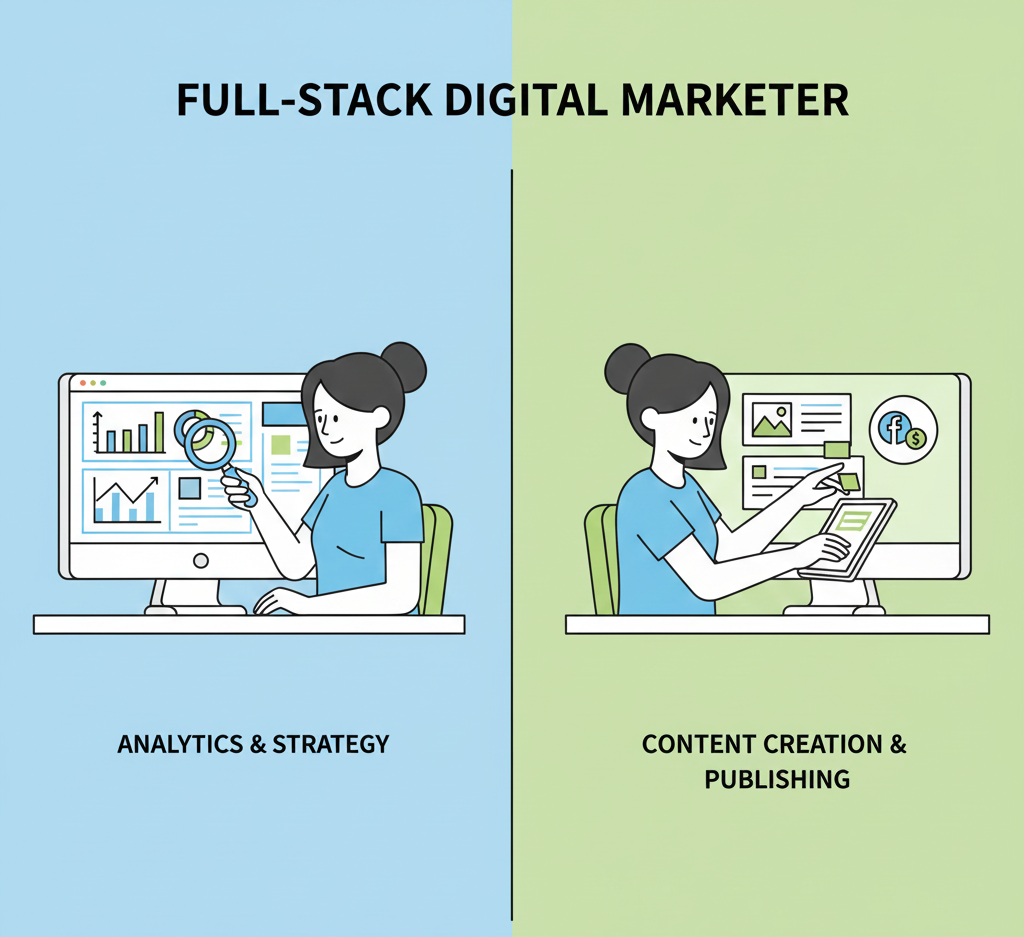
A full stack digital marketer is not a specialist in only one area like SEO or social media. Instead, you are like a “T-shaped” professional. You have broad knowledge of many channels, such as search engines, social media, email, content, and paid ads, and then you go deeper in one or two areas that you enjoy the most. This combination of breadth and depth makes you extremely valuable to startups, agencies, and even larger companies.
Imagine a small e-commerce brand that wants to grow online. As a full stack digital marketer, you might research keywords, create SEO-friendly content, run Instagram and TikTok campaigns, manage email newsletters, set up Google Ads, and analyse performance using Google Analytics. You do not need to be a world-class expert in every single thing, but you do need to understand how each piece connects to business goals like traffic, leads, and sales.
The best part is that everything you need to learn is available online, often for free. Your job is to follow a structured path instead of jumping randomly between courses and YouTube videos.
Why Becoming a Full Stack Digital Marketer Matters for Your Career
If you are a global fresher, you might be wondering why you should aim to become a full stack digital marketer instead of focusing on only one area. There are several strong reasons.
The first reason is flexibility. Digital marketing roles are evolving fast. When you know how SEO, content, social media, email, and paid ads all work together, you can adapt to different job descriptions and industries. You become someone who can join a small team and immediately add value in multiple areas.
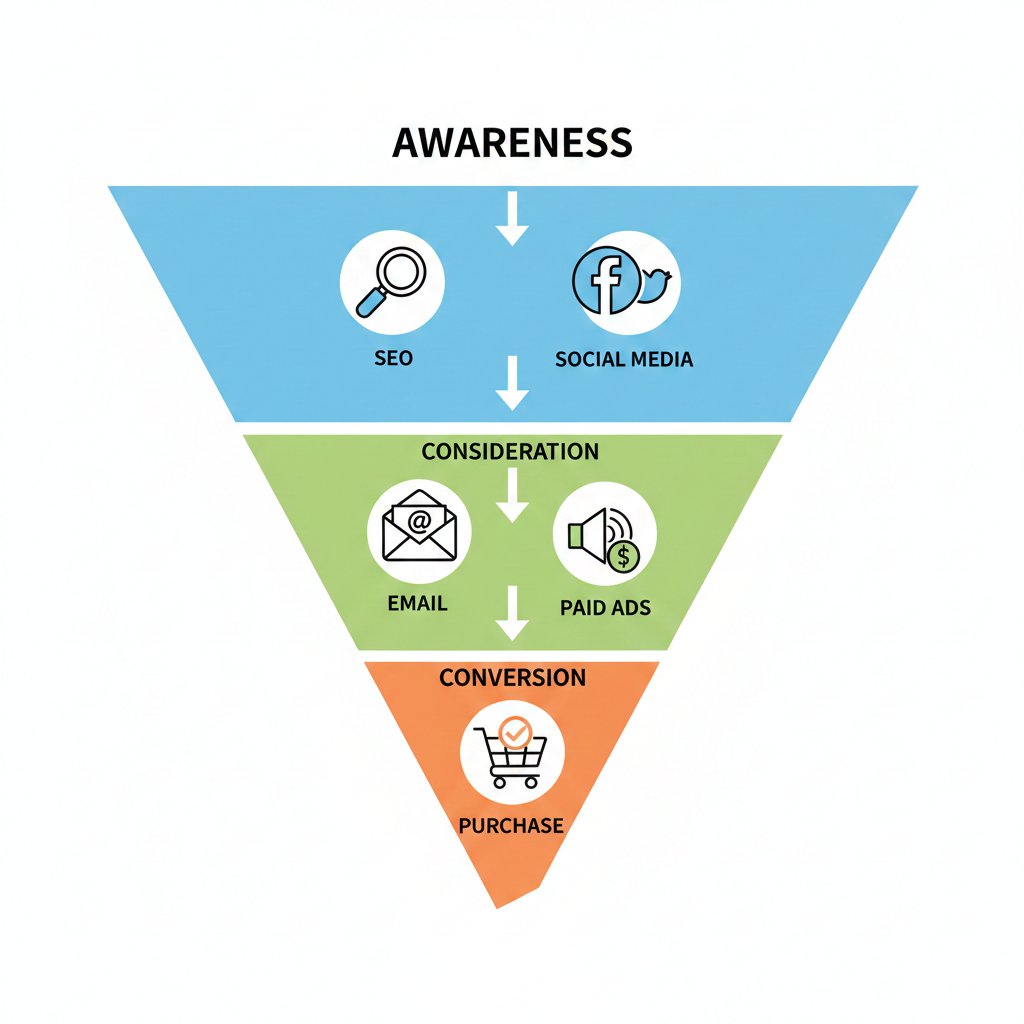
The second reason is employability. Employers love people who can see the bigger picture. When you understand the whole funnel, from awareness to conversion, you can make smarter decisions and avoid wasting money on random campaigns. This is why full stack digital marketers are often trusted with more responsibility, even when they are relatively young in their careers.
The third reason is career growth. As you gain experience, your broad skill set makes it easier to move into roles like digital marketing manager, growth marketer, or even head of marketing. If you ever want to launch your own side business, startup, or freelance practice, being able to handle most of the marketing stack yourself is a huge advantage.
For you as a fresher, this path also opens doors to remote jobs and international clients. Many startups around the world do not care where you live or what your degree is, as long as you can prove your skills through a strong portfolio and results.
What Does a Full Stack Digital Marketer Actually Do Day to Day?
To make this more real, let’s look at what your daily work might look like when you become a full stack digital marketer.
On some days, you may start by checking website analytics. You look at traffic, top pages, and sources of visitors. You notice that blog posts about a certain topic are bringing in more organic traffic, so you decide to create more content around that theme. You plan those articles, research keywords, and write or brief the content.
On other days, you might be planning a social media content calendar. You think about what your audience cares about, choose formats like reels, carousels, or short videos, and schedule posts. You respond to comments, test different styles, and see which posts lead people to click your links or sign up to your email list.
You could also be managing email marketing, where you welcome new subscribers, send weekly newsletters, and create simple automation sequences for leads. If you run paid ads, you might be testing different headlines, creatives, and targeting options on platforms like Google Ads or Meta Ads to improve your cost per lead or sale.
All of this is guided by data. You are not just posting content for fun; you are tracking what works and what does not, then adjusting your strategy. Over time, you learn to connect every activity to a clear outcome, such as traffic growth, more leads, or higher revenue.
This is why the roadmap you are about to see includes both learning and doing. You cannot become a full stack digital marketer by theory alone. You need real projects, even if they are small.
The 6–12 Month Roadmap: From Beginner to Job-Ready
Let’s break your journey into simple stages. This is a flexible roadmap. If you study full-time, you might move faster and reach your goal in 6 months. If you are studying or working alongside, you might take closer to 12 months. Both are completely fine.
Months 1–2: Build Strong Fundamentals
In the first two months, your goal is to understand the basics of marketing and the digital landscape. You should learn what a marketing funnel is, what the difference is between brand awareness and performance marketing, and how businesses think about customers, value, and competition.
This is also the time to get familiar with the main channels: search, social, email, content, paid ads, and analytics. You do not need to master them yet. You just need to understand what they are used for and how they support business goals. Think of this phase as building the foundation of your house.
You can start with free courses like Google’s Fundamentals of Digital Marketing on Google Digital Garage at https://grow.google/intl/en_in/digitalgarage/ or beginner-friendly learning paths on LinkedIn Learning at https://www.linkedin.com/learning/. As you go through these, take notes in your own words and connect concepts to real brands you follow online.
In this stage, you can also create simple accounts for tools like Google Analytics, Google Search Console, and basic social media business profiles, just to get comfortable navigating them.
Months 3–4: Focus on SEO and Content, Plus Social Media Basics
In the next two months, start going deeper into a few key skills that every full stack digital marketer should have. SEO and content marketing are great starting points, because they help you think long-term and understand user intent. At the same time, you can build your understanding of social media marketing, which is often where global freshers find their first projects.
For SEO, learn how to do keyword research, how to optimise on-page elements like titles and meta descriptions, and how to structure content so it is both user-friendly and search-friendly. During this time, it is extremely helpful to start your own simple blog or website. It could be on any topic you enjoy, such as fitness, gaming, travel, or productivity. Here you can link to a post about how to start a simple WordPress blog.
For social media, pick one or two platforms based on the kind of audiences and industries you are interested in. Learn how to write engaging captions, use basic design tools like Canva, and understand simple metrics such as reach, engagement, and click-through rate. You can create an Instagram page or LinkedIn page and treat it as your learning playground.
By the end of month four, you should have published a few blog posts or articles, tried basic SEO optimisation, and posted consistent content on at least one social platform. You are not an expert yet, but you are already more experienced than someone who has only watched videos.
Months 5–6: Learn Performance Marketing and Analytics
Now that you understand organic channels like SEO and content, it is time to explore performance marketing and analytics in more depth. A full stack digital marketer needs to be comfortable with paid ads and data, because these are often where businesses invest real money.
Start with Google Ads. Learn about search campaigns, basic keyword match types, ad copywriting, and simple bidding strategies. You can watch tutorials, take small practice exams, or follow structured paths on platforms like HubSpot Academy at https://academy.hubspot.com/ and Google Skillshop at https://skillshop.exceedlms.com/. If you have a small budget or you can partner with a friend who runs a small business, you can experiment with a tiny real campaign to see how impressions, clicks, and conversions work.
At the same time, deepen your understanding of analytics. Learn how to read key metrics like users, sessions, bounce rate, and conversion rate in tools like Google Analytics. Understand how UTM parameters work so you can track where your traffic is coming from. This might sound technical at first, but if you take it slowly and practice with your own site or a demo account, it becomes much easier.
By the end of month six, you should be able to explain the basics of organic vs paid traffic, how to track a simple funnel from ad click to conversion, and how to interpret dashboards instead of feeling lost in numbers.
Months 7–9: Build Your Portfolio and Personal Brand
From month seven onward, your focus should shift from pure learning to demonstrating your skills. Employers and clients want to see proof, not just certificates. This is where you start turning yourself into a visible full stack digital marketer.
First, improve and expand your personal website or portfolio. Show your blog posts, social media experiments, email campaigns, and any small ad campaigns you have run. For each project, write a short story: what the goal was, what you did, and what results you saw. Even if the results are small, the way you think and analyse is what matters. Here you can link to a post about how to create a digital marketing portfolio.
Next, take your LinkedIn profile seriously. Use a clear headline like “Aspiring Full Stack Digital Marketer | SEO, Social Media, Ads, Analytics.” Write a summary that shows your journey, what you are learning, and what kind of roles or projects you are interested in. Post about your learning experiences, share insights from courses, and connect with other marketers. Many freshers get their first opportunity directly through LinkedIn.
If possible, look for internships, volunteer projects, or freelance gigs, even if they are unpaid or low paid at first. You could help a local business, a student club, or a non-profit with their social media, website content, or simple campaigns. These real-world experiences will give you stories to talk about in interviews and will boost your confidence.
Months 10–12: Get Experience, Refine Your Niche, and Apply for Jobs
In the final stage of your 6–12 month roadmap, you are no longer a total beginner. You have a basic understanding of multiple channels, some real projects, and a growing portfolio. Now it is time to refine your niche and actively pursue opportunities.
Spend some time reflecting on which areas you enjoyed the most. Maybe you loved SEO and blogging. Maybe you enjoyed designing social media creatives and writing captions. Maybe analytics and ads felt exciting. As a full stack digital marketer, you still keep your broad knowledge, but it helps to have one or two focus areas where you want to go deeper.
Start applying for internships, junior digital marketing roles, or remote freelance projects. Tailor your CV and cover letter to highlight the exact skills the job description mentions, and link directly to relevant projects in your portfolio. If you are not fully confident about your CV yet, read my guide Resume Tips for Freshers: Write a CV That Gets Noticed before you start applying
Keep sharpening your interview skills by practicing answers aloud. You might feel nervous before your first interviews, and that is completely normal. Focus on telling honest stories about what you have done, what you learned, and how you approach problems. Employers appreciate authenticity and clear thinking.
Throughout months ten to twelve, keep learning and experimenting in parallel. The digital marketing world changes fast, and your growth mindset will matter just as much as your technical skills.
Essential Tools and Platforms Every Full Stack Digital Marketer Should Know
Tools are a big part of your daily life as a full stack digital marketer. The good news is that many of them are free or affordable, especially at the beginner level.
You should know the basics of website and content tools. WordPress, Webflow, or similar platforms help you understand how websites are structured, how blogs are created, and how content is updated. Even if you are not a developer, being comfortable inside a content management system will make your life much easier.
Analytics and tracking tools are also critical. Google Analytics and Google Search Console are non-negotiable for most websites. They tell you who is visiting, how they found you, and what they are doing on your pages. As you grow, you may also use tools like Google Tag Manager to manage tracking codes more easily.
For SEO, tools like Ubersuggest, AnswerThePublic, or free versions of SEMrush and Ahrefs can help you with keyword research and competitor insights. Do not worry if you cannot afford premium tools right away. You can do a lot with free versions and creative thinking.
Social media management tools like Meta Business Suite, Creator Studio, or free scheduling platforms can save you time and help you plan content across platforms. For design, Canva is a must-have, especially if you are not a professional designer. It lets you create banners, social posts, and basic ad creatives quickly.
When you work with email marketing, you will likely use platforms such as Mailchimp, Brevo, or ConvertKit. Learn how to design simple email templates, manage subscriber lists, and send basic campaigns or automations.
Finally, explore online learning platforms that keep you updated. Free or low-cost courses on sites like Google Digital Garage, LinkedIn Learning, Coursera, and HubSpot Academy are extremely valuable. You do not have to collect hundreds of certificates, but you should complete a few solid programmes that strengthen your fundamentals.
Projects You Can Do as a Fresher to Prove Your Skills
Many freshers worry that they cannot get experience without already having a job. In digital marketing, you can solve this problem by creating your own projects. These do not need to be huge; they just need to be real.
One simple project is to start your own niche blog or website. Choose a topic you genuinely care about, such as personal finance, mental health, music, or language learning. Publish well-researched articles, optimise them for search, and share them on social platforms. Over a few months, you will start seeing traffic data and learning what content works.
Another idea is to manage a social media page as if it were a client. It could be an Instagram page for book recommendations, a TikTok account sharing short study tips, or a LinkedIn page discussing digital marketing insights. Treat it seriously. Plan content, be consistent, and track growth. Even if you have only a few hundred followers, your approach and learnings matter more than big numbers at the beginning.
You can also offer to help a friend or local business. Maybe a small café needs better Google Business Profile optimisation and regular posts. Maybe a coach or tutor wants help with email newsletters. When you step in and apply your skills to real businesses, you learn things that no course can teach you.
If you feel brave, you can run a tiny paid ads experiment with a very low budget. For example, you might promote your own blog post or a simple lead magnet for a few days on Google Ads or Facebook Ads. This will give you real data on impressions, clicks, and conversions, which you can later showcase in your portfolio.
Over time, these projects become your strongest proof that you are already acting as a full stack digital marketer, not just studying to become one.

Common Mistakes Aspiring Full Stack Digital Marketers Make
As you follow this roadmap, it helps to know which mistakes to avoid. Many freshers waste months because they approach learning in a scattered way.
One common mistake is jumping from one course to another without finishing anything or applying what you learn. You might watch many videos, but if you never implement, you stay stuck at the theory level. It is better to complete fewer high-quality courses and immediately test the concepts on your own projects.
Another mistake is trying to learn every tool and platform at once. The digital marketing world is huge. If you chase every new trend, you will feel overwhelmed and inconsistent. Focus on a core stack first: SEO, content, social media, email, paid ads, and analytics. Only later, as your base becomes strong, should you explore advanced tools or very niche platforms.
Many freshers also underestimate the importance of writing and communication. Even as a full stack digital marketer, a lot of your work involves writing emails, briefs, posts, and reports. If your writing is unclear or confusing, your ideas lose power. You can improve by writing every day, even if it is just a short update on LinkedIn or a reflection in your notebook.
A different kind of mistake is being afraid to show your work. You might feel your projects are too small or not perfect. The truth is that everyone starts somewhere. When you share your journey honestly, people connect with you more, and opportunities often appear from unexpected places.
Finally, some learners ignore data and only focus on creative output. They keep posting content but never check what works or why. As a full stack digital marketer, your strength lies in balancing creativity with numbers. Do not be scared of analytics; treat it like a helpful friend that tells you the truth about your campaigns.
How to Stay Consistent and Motivated on This Roadmap
Becoming a full stack digital marketer in 6–12 months is absolutely possible, but it requires consistency. You will have days when you feel excited and days when you feel confused or stuck. That is completely normal.
One way to stay consistent is to create a simple weekly learning plan. For example, you might spend one hour a day on structured learning and another hour on applying what you learned to your own projects. If you are very busy, even thirty focused minutes daily will compound over time. The key is to show up regularly, not to study for ten hours only on weekends.
Another helpful habit is to track your progress. Keep a simple journal or digital document where you record what you learned each week, what you implemented, and what results you observed. When you look back after a few months, you will be surprised by how far you have come, and this will motivate you to keep going.
Community also matters a lot. Follow experienced marketers on LinkedIn, join relevant Facebook or Discord groups, and participate in discussions. Ask questions, share your experiments, and learn from others’ experiences. When you see other people growing, you feel encouraged to push yourself as well.
Remember to be kind to yourself. You do not need to become an expert in everything overnight. It is okay to feel overwhelmed sometimes. The most important thing is that you keep moving forward, even with small steps. Every blog post you publish, every campaign you test, and every report you read is making you a stronger full stack digital marketer.
Final Thoughts: Your Path to Becoming a Full Stack Digital Marketer
If you follow this 6–12 month roadmap with focus and patience, you can absolutely become a full stack digital marketer, even as a global fresher starting from zero. You now understand what the role involves, why it is such a powerful career choice, and how to move step by step from fundamentals to real projects, a strong portfolio, and your first job or clients.
The journey will not be perfectly linear. You will make mistakes, change your mind about certain tools, and discover new interests along the way. That is part of the learning process. What matters is that you keep learning, keep implementing, and keep sharing your work with the world.
Your future employer or client cares less about your age or location and more about your ability to think, execute, and learn. Start today, stay consistent for the next 6–12 months, and you might be surprised at how quickly your digital marketing career takes off.
FAQ: Roadmap to Become a Full Stack Digital Marketer
How long does it really take to become a full stack digital marketer?
For most people, it takes around 6–12 months of focused learning and consistent practice to become a job-ready full stack digital marketer. If you are able to dedicate more hours per week, you may move faster, but what matters more is applying what you learn through real projects.
Do I need a specific degree to start a career in digital marketing?
You do not need a specific degree to build a digital marketing career. Employers care more about your skills, portfolio, and ability to solve real problems. A degree in marketing, business, or communications can help, but many successful marketers come from completely different backgrounds such as engineering, arts, or science.
Is coding required to become a full stack digital marketer?
Basic technical understanding is useful, but you do not need to be a programmer. Knowing simple concepts like how websites are structured, what HTML tags are, or how tracking codes work will help you collaborate better with developers. However, your main focus as a full stack digital marketer will be strategy, content, campaigns, and analytics, not writing complex code.
How many hours per week should I study and practice?
If you are serious about following this roadmap, aim for at least 7–10 hours per week, combining both learning and implementation. If you can manage 15–20 hours weekly, your progress will be even faster. It is better to study consistently in smaller chunks than to burn out with long, irregular sessions.
What entry-level jobs can I apply for after following this roadmap?
After 6–12 months of focused learning and building a portfolio, you can apply for roles like digital marketing intern, junior digital marketing executive, SEO executive, social media marketing associate, content marketing assistant, or performance marketing trainee. These roles let you use your broad skills and grow into a more advanced full stack digital marketer over time.