

If you want to start a career in digital marketing but do not have any clients yet, you might feel stuck. Every job post asks for experience and a digital marketing portfolio, but to get that experience you feel like you need a job first. It looks like a loop you can never escape.
The good news is that you can absolutely build a strong digital marketing portfolio with no clients at all. Many successful marketers started exactly where you are now. They used personal projects, mock brands, and small experiments to prove their skills before anyone paid them.
In this guide, you will see step by step how to create a digital marketing portfolio that feels real and professional, even if your only “client” right now is yourself. You will learn what to include, how to present it, and how to talk about your work with confidence when recruiters or clients ask to see proof.

What a Digital Marketing Portfolio Really Is (and Is Not)
Before you start building anything, you need a clear idea of what a digital marketing portfolio actually is. Many beginners think it is just a folder full of screenshots or a list of links. That is part of it, but not the whole story.
A digital marketing portfolio is a collection of projects and case studies that show how you think, what you can do, and what results you can create. It is more than a gallery; it is a story about your skills. When someone looks at your digital marketing portfolio, they should be able to understand three things: what kind of marketer you are, what types of work you have done, and why you are different from the next candidate.
It is also not just for “creative” roles. Whether you want to focus on SEO, paid ads, social media, email marketing, or analytics, you still benefit from a digital marketing portfolio. Instead of just telling people “I know Google Ads” or “I understand Instagram,” you show them specific campaigns, test results, or content you have worked on.
Another important point: your digital marketing portfolio is not a static museum. It is a living document. You will add, remove, and improve projects as you grow. Thinking of it this way takes some pressure off. You do not need a perfect portfolio on day one. You just need a clear, honest starting point.
Why You Can Build a Digital Marketing Portfolio Without Clients
It might feel strange to talk about a digital marketing portfolio when you have never been hired yet, but that is exactly why self‑initiated projects exist. Companies are not only looking for official job titles; they are looking for proof that you can solve problems with digital tools.
When you understand this, you see that a digital marketing portfolio can include different types of projects, not just paid client work. For example, you can create campaigns for your own personal brand, help a friend or family member grow a small business online, or design a full strategy for a completely imaginary brand that feels real. As long as you treat the project seriously and track real numbers, it belongs in your digital marketing portfolio.
You also live in a time where it is easier than ever to run small experiments. You can create and grow a niche Instagram page, write SEO‑optimised blog posts on a simple website, run a low‑budget ad campaign, or build an email list around a hobby topic. All of these can become case studies in your digital marketing portfolio if you document what you did and what happened.
Recruiters know that beginners rarely have huge brand names in their history. They care more about your approach. When they open your digital marketing portfolio, they want to see how you set goals, chose channels, created content, analysed performance, and adjusted your strategy. If you can show this using your own projects, you are already ahead of many people who only list buzzwords on their CV.
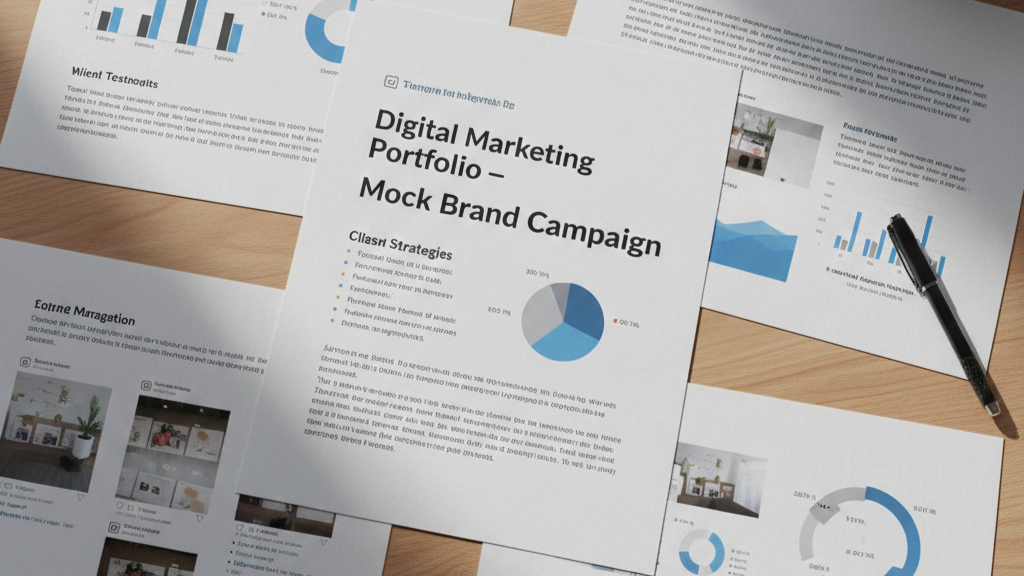
Laying the Foundations of Your Digital Marketing Portfolio
Before you rush into creating campaigns, it helps to build a simple foundation for your digital marketing portfolio so everything you create has a clear home and direction.
Choose Your Focus and Audience
Digital marketing is a huge field. If your digital marketing portfolio tries to show everything at once, it can feel unfocused. Instead, think about what kind of work you want to be hired for first. Are you more drawn to social media, SEO, paid ads, content marketing, email marketing, or analytics?
You do not have to lock yourself into one thing forever, but choosing one or two focus areas makes it easier to design projects that make sense. If you love social media, your digital marketing portfolio should include strong examples of content calendars, growth strategies, and engagement results. If you love SEO, your projects should highlight keyword research, on‑page optimisation, and organic traffic improvements.
You should also consider who you want to impress. A hiring manager at an agency might care about different things than a small business owner or a startup founder. For example, agencies may value variety and creativity, while small businesses may care more about simple, measurable results like leads or sales. Keeping your audience in mind will shape how you present your digital marketing portfolio.
Set Up a Simple Home for Your Portfolio
Your digital marketing portfolio needs a place to live online. This does not have to be a fancy custom website on day one. You can start with a simple layout on platforms like Notion, a basic WordPress site, a Google Sites page, or even a well‑organised PDF hosted on Google Drive.
At minimum, your digital marketing portfolio home should have a short “About” section, a clear list of your main skills or interests, and a set of project pages or case studies. Each project should be easy to click into and read without confusion. If someone finds your portfolio on LinkedIn at https://www.linkedin.com/, they should quickly see where to go to understand your work.
Later, as you grow, you can upgrade your digital marketing portfolio into a more polished website with your own domain. For now, focus on clarity and function rather than visual perfection.
Creating Strong Portfolio Projects Without Clients
Now comes the creative part: filling your digital marketing portfolio with projects that prove what you can do. Remember, these do not have to be paid client projects. They simply have to be real, structured efforts.
Use Personal or Mock Brands as Your “Clients”
If you have no clients, you can create them. Pick a niche or industry you care about, such as fitness, fashion, local cafés, online courses, or pet products. Then invent a realistic brand in that space. Give it a name, a basic story, a target audience, and a rough product or service offering.
Now treat that brand as a real client for your digital marketing portfolio. Create a short brief for yourself: what is the goal, what problem are you solving, what platforms will you use, and how long will the campaign run? Approach it with the same seriousness you would bring to a paying client.
You can also use yourself as the brand. If you are building a personal brand on LinkedIn or Instagram, document your own growth journey as a case study in your digital marketing portfolio. Show how you started, what content you used, what experiments you ran, and what results you saw in followers, engagement, or leads.
Document the Process, Not Just the Final Look
A common beginner mistake is to fill a digital marketing portfolio with pretty designs but no story. Hiring managers are not only interested in how something looks; they want to know how you thought.
For each project in your digital marketing portfolio, include sections like these in your own words: the context and goal, your research and insights, the strategy you chose, the actions you took, and the results you recorded. If you changed direction during the project, explain why. If something failed, be honest and show what you learned.
You can even take inspiration from professional case studies on sites like HubSpot at https://blog.hubspot.com/marketing/case-study-examples to see how experienced teams describe their work. Then adapt that structure for your own digital marketing portfolio.
Show Numbers, Even Small Ones
Numbers make your digital marketing portfolio feel real. You might not have huge budgets or massive audiences yet, but you can still show meaningful metrics. For example, you can highlight percentage growth in followers, click‑through rates on emails, engagement rates on posts, or improvements in website traffic.
If your sample ad campaign generated only a few leads, that is okay. What matters is that you tracked them and can explain the cost per lead, the targeting you used, and what you would try next time. A digital marketing portfolio full of clear, honest numbers is much more impressive than one full of vague claims like “this performed well.”
Screenshots of analytics dashboards, ad managers, and content insights are powerful additions. Just make sure to blur or remove any sensitive personal information and to explain what each screenshot means. Do not assume the reader will interpret the data correctly without your guidance.
Presenting Your Digital Marketing Portfolio Like a Professional
You can do great work and still fail to impress if your digital marketing portfolio is hard to read or navigate. Presentation matters almost as much as the projects themselves.
Give your portfolio a simple structure. Start with a short introduction where you explain who you are, what you like to work on, and what kind of roles or clients you are interested in. Then list your key projects with clear titles, like “Instagram Growth Strategy for Mock Café Brand” or “SEO Content Plan for Personal Blog.” Clicking each title should lead to a dedicated page or section.
Inside each project page, keep the layout consistent. For example, always begin with an overview, then the problem, your approach, the execution, and the results. This makes it easy for a busy recruiter to scan several projects in your digital marketing portfolio quickly and still understand your thinking.
Write in clear, simple language. Avoid stuffing your digital marketing portfolio with jargon like “synergy” or “omnichannel optimisation” if you cannot explain those terms plainly. It is better to say “I created a weekly content schedule for three platforms” than “I executed a cross‑platform content cadence.” Clarity makes you look more confident.
Do not forget your contact details. At the end of your digital marketing portfolio, or in a sticky header or footer, include a way to reach you: email, LinkedIn, or portfolio form. Make it easy for someone who likes your work to take the next step.

Common Mistakes When Building a Digital Marketing Portfolio with No Clients
As you build your digital marketing portfolio, it helps to know where many beginners slip so you can avoid their mistakes.
One mistake is copying other portfolios too closely. It is fine to get inspiration from layouts and structures, but if you copy content or pretend to have worked with brands you never touched, you damage your credibility. Your digital marketing portfolio should reflect your real efforts, not a fantasy life.
Another mistake is including every small thing you have ever done. If your digital marketing portfolio is crowded with random screenshots, half‑finished ideas, and outdated work, it becomes confusing. It is better to feature three to six strong, well‑explained projects than twenty weak ones. As you grow, you can replace older projects with newer, better ones.
Some people hide their digital marketing portfolio or never share it. They build it, feel shy, and then keep it in a folder. A portfolio is only useful if people see it. Share it on LinkedIn, include it in applications, and send it when someone asks about your skills. Even if it feels imperfect, remember that almost no one’s digital marketing portfolio is perfect. It is always a work in progress.
Finally, many beginners never connect their portfolio to a bigger learning path. They build a few projects and then stop. In reality, your digital marketing portfolio becomes more powerful when it is linked to a clear roadmap of skills you are still developing. If you want a structured path, you can later explore more advanced guides such as Roadmap to Become a Full Stack Digital Marketer in 6–12 Months so that the projects in your portfolio match the roles you are aiming for.
Final Thoughts: Start Your Digital Marketing Portfolio Now, Not Later
It is easy to wait. You might tell yourself you will build a digital marketing portfolio “after” you take one more course, “after” you get your first client, or “after” you feel completely ready. But that day rarely comes on its own. In reality, your portfolio is one of the tools that helps you get that first client or job in the first place.
You now understand that a digital marketing portfolio is not reserved for people with big brand logos on their CV. It is a living collection of projects, experiments, and stories that show how you think and what you can do. You have seen how to choose a focus, create mock or personal projects, document your process, and present everything in a clear, professional way.
If you start small today—one project, one page, one honest case study—you are already far ahead of someone who just writes “passionate about marketing” on their resume. Keep building, keep refining, and let your digital marketing portfolio grow alongside your skills. Opportunities often come to the people who are willing to show their work.
FAQ: Building a Digital Marketing Portfolio with No Clients
Can I really get hired with a digital marketing portfolio built on mock projects?
Yes. Many junior marketers are hired based on strong self‑initiated projects. Employers care more about your thinking, skills, and results than whether someone paid you for each project. Be honest about which projects are mock or personal, and explain them clearly.
How many projects should I include in my digital marketing portfolio?
For a beginner, three to six solid projects are usually enough to show range without overwhelming the reader. You can always add more later, but focus first on making each case study in your digital marketing portfolio detailed and clear.
Do I need a custom website for my digital marketing portfolio?
A custom website is nice but not required at the start. You can host your digital marketing portfolio on simple platforms like Notion, Google Sites, or a basic template. What matters most is the quality of your projects and how clearly you explain them.
What if my projects do not have big results or numbers?
Small numbers are still useful if they are real and explained. For example, growing an account from 50 to 150 followers or improving click‑through rate by a few percent can still show skill. In your digital marketing portfolio, focus on what you tried, why, and what you learned, not just on big metrics.
How often should I update my digital marketing portfolio?
Aim to review your digital marketing portfolio every few months. Remove weaker or outdated projects, add your best new work, and adjust your introduction to match the roles or clients you are currently targeting. Treat it as a living tool, not a one‑time task.