

If you are a young professional juggling rent, bills, student loans, and maybe a few credit cards, you are not alone. Debt can feel like a heavy weight on your shoulders, especially at the start of your career. The good news is that with a clear debt payoff plan, you can stop feeling lost and start moving step by step toward freedom, even if your salary is modest right now.
In this guide, I will walk you through what a debt payoff plan actually is, why it matters so much for your future, and how you can create one that fits your real life. No unrealistic “pay everything off in three months” promises, just honest, practical advice that respects the fact you still need to eat, pay rent, and have a life.
You will learn how to understand your debt, choose the right strategy, avoid common mistakes, and stay motivated when progress feels slow. If you have ever felt ashamed or scared to even open your banking app, I want you to know that it is completely normal. Taking control of your money is a process, and reading this is already a strong first step toward building your own debt payoff plan.
The Reality of Debt for Young Professionals
For many young professionals, debt starts before the first full-time job. Maybe you used student loans to get through college. Maybe you relied on credit cards during an internship or low-paying job. Maybe you took out a personal loan to cover medical expenses, family needs, or unexpected emergencies. On their own, none of these choices make you a bad or irresponsible person.

The problem usually appears when these different loans and cards stack up. You might have a student loan with one interest rate, a credit card with a higher rate, and a buy-now-pay-later plan all running at the same time. Each month, money leaves your account, but the balances do not seem to move much. This is where a proper debt payoff plan becomes essential.
Debt does not just affect your bank account. It can impact your mental health, your relationships, and even your performance at work. It is hard to focus on your job or enjoy time with friends when you are worried about late fees and rising interest. Many young professionals feel embarrassed and try to ignore their situation, but that usually makes things worse over time.
The truth is that debt is extremely common, and there are proven ways to manage it. Your goal is not to magically erase everything overnight. Your goal is to understand your situation clearly and then follow a realistic debt payoff plan that you can stick to.
What Is a Debt Payoff Plan?
A debt payoff plan is simply a clear, organised strategy for how you will pay off your debts over time. Instead of paying random amounts whenever you feel like it, you decide in advance how much you will pay, in what order, and from which income sources. It turns a scary, vague problem into a series of small, specific actions.
Without a debt payoff plan, you might pay only the minimums, use whatever is left in your account at the end of the month, or rely on emotions to decide which card to pay. Some months you might pay more, other months less, and you never know whether you are making real progress. With a plan, you know exactly which debt you are attacking first, how much you are sending to it, and what timeline you are aiming for.
A good debt payoff plan usually includes a complete list of your debts, the interest rates, and the minimum payments. It also connects to your monthly budget, so you know how much you can actually afford to pay without starving or skipping rent. Most importantly, it is flexible. Your situation can change, and your plan should be able to adjust when that happens.
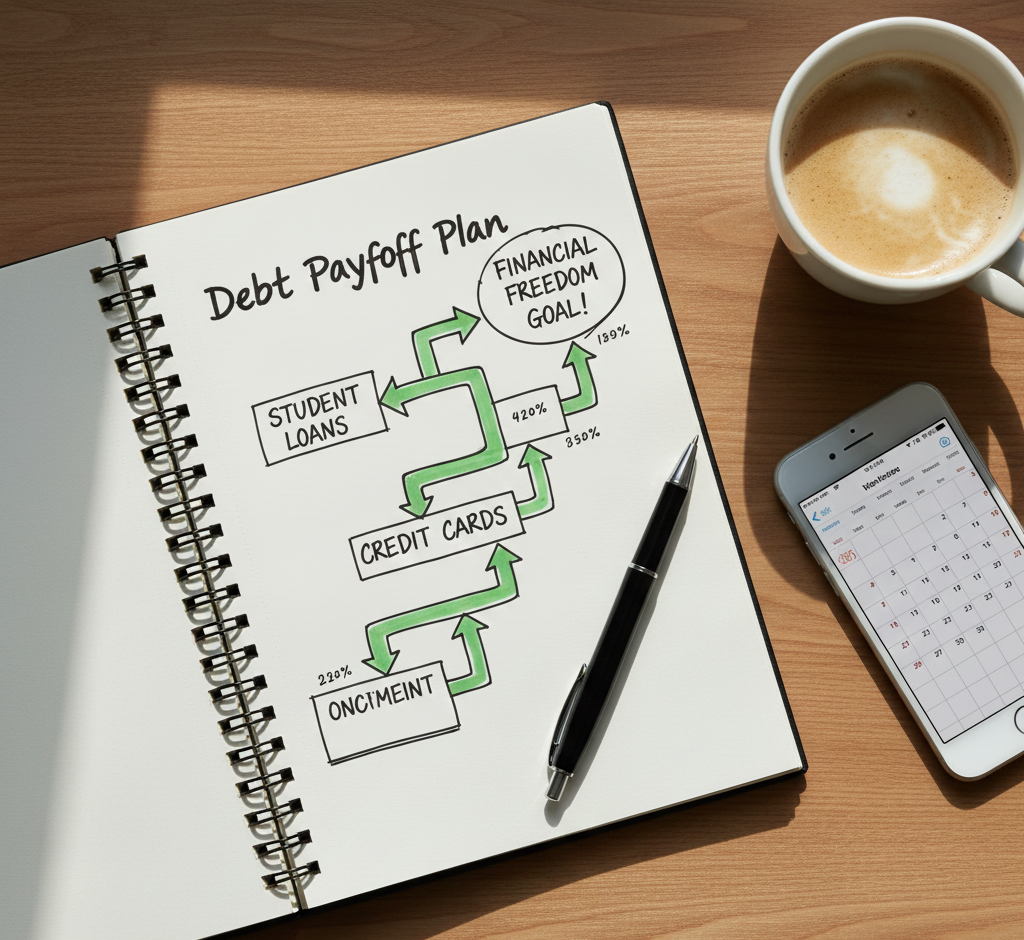
Think of your debt payoff plan as a map. The debts are the roads and obstacles. The plan is the route you choose so you do not wander in circles. You still have to walk the path, but at least you know where you are going.
Why a Debt Payoff Plan Matters for Your Career and Future
You might see your debt as a purely financial problem, but it is deeply connected to your career and life choices. When you carry heavy debt without a solid debt payoff plan, you may feel trapped in jobs you hate simply because you are afraid you cannot afford to change. You might avoid taking positive risks like moving to a new city, investing in a course, or switching industries.
Financial stress also affects your performance at work. It is hard to bring your best self to your job when you are constantly worrying about overdue bills. Over time, this can limit promotions, raises, and opportunities that would actually help you earn more and pay off debt faster.
On the other hand, when you follow a debt payoff plan, you start to feel in control. Even if the numbers are still big, you know you are moving in the right direction. This confidence can spill over into your career. You might suddenly feel more comfortable negotiating your salary, applying for better roles, or You might suddenly feel more comfortable negotiating your salary, applying for better roles, or starting a side income project that adds to your payoff plan. If you want structured ideas for that, read my guide How to Build a Side Income Online While Studying
A clear plan also protects your future self. The habits you build now—tracking your money, paying on time, choosing smart loans, and avoiding unnecessary debt—will help you when you want to buy a car, a home, or start a business. Your younger self’s discipline becomes your older self’s freedom.
For young professionals, this is not just about numbers. It is about giving yourself more choices and less stress in the years ahead.
Step-by-Step: Building Your Personal Debt Payoff Plan
Creating a debt payoff plan can feel intimidating at first, but once you break it into steps, it becomes much more manageable. You do not need to be a finance expert. You just need honesty, a calculator, and a bit of courage.
Take an Honest Snapshot of Your Debts and Income
The first step in any effective debt payoff plan is facing the full picture. This is often the most emotionally difficult part, because you might be afraid of what you will see. Take a deep breath and remind yourself that knowing the truth is power, not shame.
Gather all your debts in one place. List your student loans, credit cards, personal loans, overdraft balances, and any money you owe to buy-now-pay-later services. For each one, note the total amount owed, the interest rate, the minimum monthly payment, and the due date.
Then look at your income. Include your primary salary, any side income, and any regular financial support you receive. If your income changes month to month, take an average or use the lower, safer estimate. Your debt payoff plan must be grounded in what you actually earn, not in wishful thinking.
Once you see everything together, you might feel a mix of shock and relief. Shock because the total might be higher than you expected. Relief because now, for the first time, you can design a clear debt payoff plan instead of guessing.
Choose a Strategy for Your Debt Payoff Plan
There are two popular strategies that most people use inside a debt payoff plan: the snowball method and the avalanche method. Both work, and the “best” one often depends on your personality.
With the snowball method, you focus on paying off the smallest balance first while still paying the minimums on all other debts. This gives you a quick win and a sense of progress. You can learn more about how this strategy works on sites like Investopedia.
With the avalanche method, you focus on the highest-interest debt first, because that one costs you the most over time. This is mathematically more efficient and usually saves you more money in the long run, which many experts and organisations like the Consumer Financial Protection Bureau recommend.
You can choose one method or mix them slightly. For example, you might pay off a couple of very small debts quickly for motivation, then switch to an avalanche-style debt payoff plan. What matters is that you choose a clear order instead of jumping randomly between debts.
Build a Starter Emergency Buffer
It might sound strange, but a strong debt payoff plan usually includes a small emergency buffer. If every extra cent goes to debt and you have no savings at all, a single unexpected expense—a medical bill, a car repair, or even a broken laptop—can push you back into more debt.
Aim to keep a small emergency fund while you work on your debt payoff plan. For many young professionals, this might be starting with an amount like one month of essential expenses, then slowly growing it later. This cushion doesn’t need to be perfect, but it can help you avoid reaching for the credit card every time something goes wrong.
You can park this money in a basic savings account that you do not touch unless it is a real emergency. Knowing that you have even a small backup can reduce anxiety and help you stay more consistent with your plan.
Create a Realistic Monthly Debt Payoff Plan
Now that you know your debts, your income, and your strategy, it is time to turn it into a monthly debt payoff plan. Start with your take-home income. Subtract your essential expenses: rent, utilities, groceries, transport, basic insurance, and any non-negotiable commitments. Be honest, but also look for areas where you may be overspending without realising it.
Whatever is left after these essentials is your “available money.” From this amount, you set aside something small for your emergency buffer if you have not built it yet. The remaining portion becomes your monthly debt payoff money.
Assign this money according to your chosen strategy. You pay the minimum on every debt to avoid late fees and penalties. Then you put all remaining extra onto the one debt you are focusing on first in your debt payoff plan. When that one is cleared, you roll its payment into the next debt on your list, and so on.
Your plan should stretch you a little but not break you. If you feel completely deprived and miserable every single month, you are more likely to give up. It is okay to keep a small budget for simple joys like a coffee with friends or a streaming subscription, as long as you are still progressing.
Cut Costs and Boost Income Intentionally
A powerful debt payoff plan has two engines: reducing expenses and increasing income. Many people only focus on cutting costs, but there is a limit to how much you can cut. There is often more long-term potential in increasing what you earn.
Still, it is worth reviewing your expenses. See if you can downgrade subscriptions, cook more at home, share costs with roommates, or use public transport instead of rideshares. Even small adjustments can free up extra money to feed your debt payoff plan.
On the income side, look at the skills you already have. Could you freelance, tutor, do part-time remote work, or handle small projects on weekends? Even a modest side income, if fully directed toward your targeted debt, can speed up your progress. Here you can link to a post about building a side income online while studying or working.
Remember that this phase does not have to last forever. You are making extra efforts now to create a future where your money belongs to you, not to lenders.
Automate Payments and Track Your Progress
Once your debt payoff plan is set, make it as automatic as possible. Set up automatic payments for at least the minimum amounts on each debt, scheduled just after your salary arrives. This reduces the risk of forgetting and paying late fees.
For the extra amount you pay toward your focus debt, you can also automate it or set recurring reminders so you do not skip it “just this month.” Every time you get a bonus, tax refund, or unexpected extra money, consider adding at least a portion of it to your debt payoff plan.
Tracking progress is just as important as making payments. Each month, write down your new balances. Celebrate every small drop. You can use a simple spreadsheet, a budgeting app, or even a handwritten chart on your wall. Seeing the numbers go down, even slowly, can keep you going when motivation dips.
Adjust Your Debt Payoff Plan Without Guilt
Life is not predictable. You might lose a job, move cities, face a medical issue, or decide to invest in a course to grow your career. When circumstances change, your debt payoff plan should adapt too.
If your income drops, you may need to temporarily reduce extra payments and just focus on covering minimums until you stabilise. If your income rises, you might choose to send more money to debt or balance between debt payments and investments in your skills or savings. Here you can link to a post about planning your finances in your 20s.

Adjusting your plan is not failure. It is smart management. The point of a debt payoff plan is to serve your life, not to control you in a rigid way. As long as you keep moving in the right direction over time, you are doing well.
Common Mistakes People Make With Their Debt Payoff Plan
When young professionals start their first debt payoff plan, they often run into similar traps. Knowing these in advance can save you money and stress.
One common mistake is ignoring interest rates completely. You might feel more comfortable paying off a small, low-interest loan first because it feels achievable, but meanwhile a high-interest credit card is quietly growing. If you choose the snowball method for motivation, that is fine, but be aware of the trade-off and consider switching to an avalanche-style approach as soon as you can.
Another mistake is taking on new debt while trying to pay off old debt. It is easy to think, “I’ll just use my credit card this month and get back on track later,” especially when money is tight. But every time you do that, your debt payoff plan gets weaker. Wherever possible, press pause on new borrowing for non-essential things until you are in a stronger position.
Many people also fall for quick-fix promises. You may see ads for magical debt solutions or consolidation offers that sound too good to be true. Some consolidation loans are helpful, but others come with high fees or very long repayment periods that cost more in the end. Before you add anything new to your debt payoff plan, read the fine print and, if possible, research on trusted sites like Investopedia or official government finance pages in your country.
A different kind of mistake is trying to be too perfect. You may design a very strict debt payoff plan, follow it for two months, then slip once and feel like it is all ruined. That shame can lead you to completely abandon the plan. Instead, accept that some months will be harder than others. If you fall off track, restart as soon as you can. Progress is rarely a straight line.
Finally, some young professionals ignore their emotional relationship with money. If you use shopping to cope with stress or feel guilty whenever you spend on yourself, your debt payoff plan will be harder to follow. Learning about your own habits and triggers, maybe even talking to a mentor or counsellor, can make your plan much more sustainable.Staying Motivated on Your Debt Payoff Journey
A debt payoff plan is not a one-week project. It can take months or even years, depending on how much you owe and how much you can pay. Staying motivated for that long is challenging, but not impossible.
One way to stay motivated is to break big goals into smaller milestones. Instead of only thinking, “I have to clear all this debt,” you can focus on paying off the first credit card, then the second, then reducing your student loan below a certain number. Every time you hit a milestone in your debt payoff plan, celebrate in a simple, low-cost way, like a special meal at home or a movie night.
Visual reminders can also help. You might create a chart or thermometer graphic that you colour in as your debt decreases. You can stick it on your wall or keep it as your phone wallpaper. When you feel discouraged, looking at how far you have already come can give you a boost.

Community matters too. You do not have to share all your financial details with everyone, but having one or two trusted people you can talk to about your debt payoff plan can make you feel less alone. You might also follow personal finance educators on platforms like LinkedIn or YouTube, where they share tips and real stories of people paying off debt.
Most importantly, be kind to yourself. You are not just numbers on a spreadsheet. You are a human being learning to manage money in a world that often pushes you toward overspending and easy credit. Some days you will feel strong and disciplined; other days you will feel tired and tempted. That does not mean your debt payoff plan is failing. It just means you are normal.
Final Thoughts: Your Debt Payoff Plan Is a Long-Term Gift to Yourself
Designing and following a debt payoff plan as a young professional is one of the most powerful gifts you can give your future self. It may not always feel exciting in the moment—saying no to extra purchases, working an extra shift, or directing bonus money to loans instead of treats—but the result is more freedom, less stress, and more choices.
You now know what a debt payoff plan is, why it matters for your career and future, and how to create one based on your real numbers and real life. You have seen the common mistakes and some ways to stay motivated when the journey feels long.
You do not have to be perfect. You just have to be consistent. Every intentional payment you make, every small bit of progress you track, and every smart decision you choose today moves you closer to a life where your income belongs to you—not to banks, credit card companies, or lenders. Start where you are, use this guide as your starting point, and let your debt payoff plan grow stronger month after month.
FAQ: Debt Payoff Plan for Young Professionals
How long will it take to finish my debt payoff plan?
The time it takes depends on how much you owe, your interest rates, and how much you can pay each month. For some young professionals it may take one to three years, for others longer. The key is to focus on steady progress rather than a fixed deadline.
Should I save or pay off debt first?
Most experts suggest a small emergency buffer first, then focusing on your debt payoff plan. Without any savings, you may be forced to take on more debt whenever something unexpected happens. Once you have a small cushion, you can direct more money toward your highest-priority debts.
Is consolidating my loans a good idea?
Consolidation can be part of a smart debt payoff plan if it genuinely lowers your interest rate, simplifies payments, and does not extend your term too much. However, some offers come with high fees or long terms that cost more in the end. Always compare the total cost and read trusted resources before deciding.
Can I still invest while following a debt payoff plan?
In the early stages, most young professionals focus on building a small emergency fund and then aggressively paying off high-interest debt. Once your expensive debts are under control, you can gradually shift more money to long-term investing. Balancing both is possible, but high-interest debt is usually the bigger emergency.
What if I miss a payment in my debt payoff plan?
Missing a payment does not destroy your entire plan, but it can hurt your credit score and add fees. If it happens, contact your lender as soon as possible, make the payment, and see whether you can adjust due dates or set up automatic payments to avoid it in future. Then get back to your regular debt payoff plan without dwelling too much on the mistake.