

Disclaimer: This article is for educational purposes only and is not financial or investment advice. Always do your own research and consider speaking with a licensed professional before investing.
1. Crypto, Bitcoin, and Blockchain — What’s the Difference?
If you feel confused by the terms “crypto”, “Bitcoin”, and “blockchain”, you’re not alone. They’re often used interchangeably, but they’re not the same thing.

Cryptocurrency (or “crypto”)
- A broad term for digital assets that use cryptography and typically run on a blockchain.
- Examples: Bitcoin (BTC), Ethereum (ETH), Solana (SOL), and thousands of smaller coins and tokens.
- They can be used as money, for payments, for accessing services, or as “utility tokens” in apps.
Bitcoin
- The first and largest cryptocurrency by market value.
- Created in 2009 by an unknown person (or group) called Satoshi Nakamoto.
- Often described as “digital gold” because:
- Supply is limited to 21 million coins.
- No central authority like a government or central bank controls it.
- Many everyday investors focus on Bitcoin first because it’s the most established and widely recognized.
Blockchain
- The underlying technology that makes cryptocurrencies possible.
- Think of blockchain as a public, digital ledger:
- Transactions are grouped into “blocks”.
- Each block is linked (or “chained”) to the previous one.
- Once data is added, it’s extremely hard to change.
- Many different blockchains exist:
- Bitcoin runs on the Bitcoin blockchain.
- Ethereum runs on the Ethereum blockchain, which also supports smart contracts and many apps.
In short:
Blockchain is the technology.
Crypto is the digital asset.
Bitcoin is the biggest and most famous cryptocurrency.
2. Why Do People Care About Crypto?
Crypto is not just about getting rich quick (although that’s the narrative you often see on social media). Here are the main ideas that attract investors:
- Store of value (especially Bitcoin)
- Some people see Bitcoin as “digital gold”: scarce, global, and independent of any one country.
- They believe it can protect wealth long term, especially against inflation or currency devaluation.
- Faster, borderless payments
- Crypto can move across borders quickly, often 24/7.
- In some countries, it’s used to send remittances or to bypass unstable local currencies.
- Smart contracts and decentralized apps (dApps)
- Blockchains like Ethereum allow code to run on-chain (“smart contracts”).
- This powers decentralized finance (DeFi), NFTs, and various apps without a traditional middleman.
- Speculation and high-growth potential
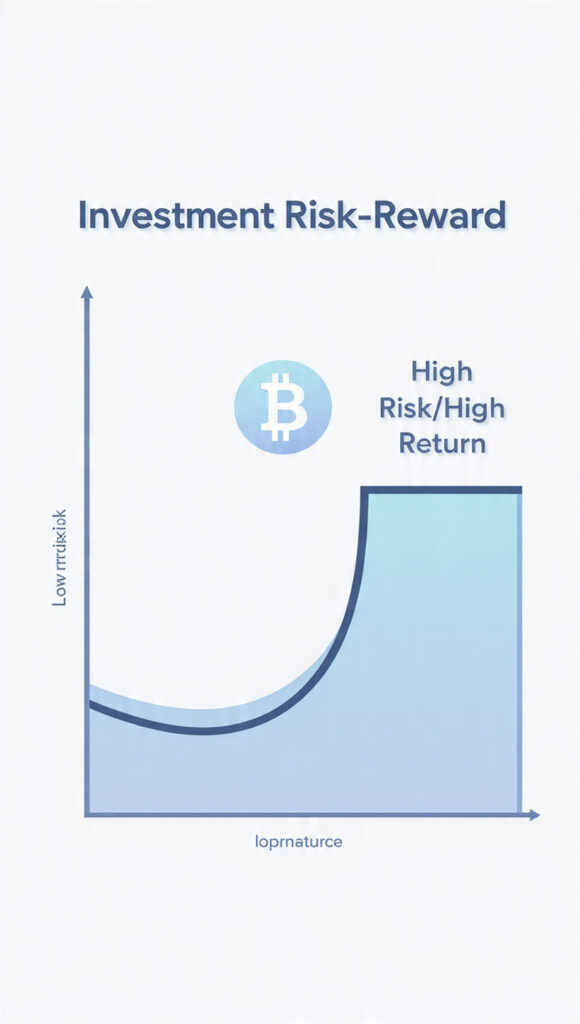
- Crypto is high risk, high reward.
- Prices can rise dramatically—but they can also crash just as fast.
For everyday investors, the key is understanding both the potential and the downside—not just chasing hype.
3. The Upside: Potential Benefits for Everyday Investors
If you decide to get involved, here are some potential advantages:
3.1 Growth potential
- Crypto has produced some of the largest gains of any asset class in the last decade.
- Early Bitcoin investors saw enormous returns—but remember, past performance is not a guarantee.
3.2 Diversification
- Crypto doesn’t always move in lockstep with stocks or bonds.
- A small allocation (for example, 1–5% of your portfolio) may improve diversification—but it also adds meaningful risk.
3.3 Accessibility
- You can start with small amounts, often with user-friendly mobile apps.
- Markets run 24/7, unlike stocks that only trade during market hours.
4. The Downside: Major Risks You Must Understand
Crypto isn’t a free lunch. Before you invest a single dollar, you need to understand the main risks.
4.1 Extreme volatility
- Prices can move 10–30% in a single day.
- It’s common to see:
- Multi‑month rallies followed by deep crashes (“crypto winters”).
- Years of sideways or down markets.
If seeing your investment drop 50% or more would cause panic or sleepless nights, be very cautious with crypto.
4.2 Regulatory and legal risk
- Different countries treat crypto very differently:
- Some are embracing it.
- Others restrict or ban certain activities.
- New regulations can:
- Affect which platforms you can use.
- Change tax rules.
- Impact the value of certain projects or tokens.
4.3 Security and custody risk
You must decide who holds your crypto:
- On an exchange (like a broker):
- Easier for beginners.
- But if the exchange is hacked, mismanages funds, or goes bankrupt, you may lose access.
- Self‑custody in your own wallet (hardware or software):
- You control your own private keys—“Not your keys, not your coins.”
- But if you lose your recovery phrase or send funds to the wrong address, they’re usually gone forever.
4.4 Scams, fraud, and “rug pulls”
The crypto world has many bad actors:
- Fake projects that disappear with investor money.
- Inflated promises of “guaranteed returns”.
- Impersonation scams on social media and messaging apps.
If something sounds too good to be true, it almost always is.
4.5 Technology and competition risk
- Thousands of cryptocurrencies exist—most will likely fail long term.
- New technologies and competitors can make older projects less relevant.
For everyday investors, this often leads to a simple strategy:
If you invest at all, focus mainly on the largest, most established coins like Bitcoin (and possibly Ethereum), not tiny speculative tokens.
5. How Much (If Any) Should You Invest?
This is personal—but here’s a framework, not advice.
- Only use money you can afford to lose
- Crypto should never be funded with rent money, emergency funds, or essential savings.
- Keep allocation small
- Many conservative investors who choose to invest limit crypto to 1–5% of their portfolio.
- Aggressive investors might go higher, but that increases the chance of large drawdowns.
- Start with Bitcoin (and maybe Ethereum)
- As a beginner, avoiding small “altcoins” may reduce risk.
- Consider treating Bitcoin as your “core” crypto exposure.
- Use dollar-cost averaging (DCA)
- Instead of throwing in a lump sum, some investors buy small, regular amounts over time (weekly or monthly).
- This approach reduces the impact of short‑term price swings.
6. How to Get Started Safely: A Simple Step‑by‑Step
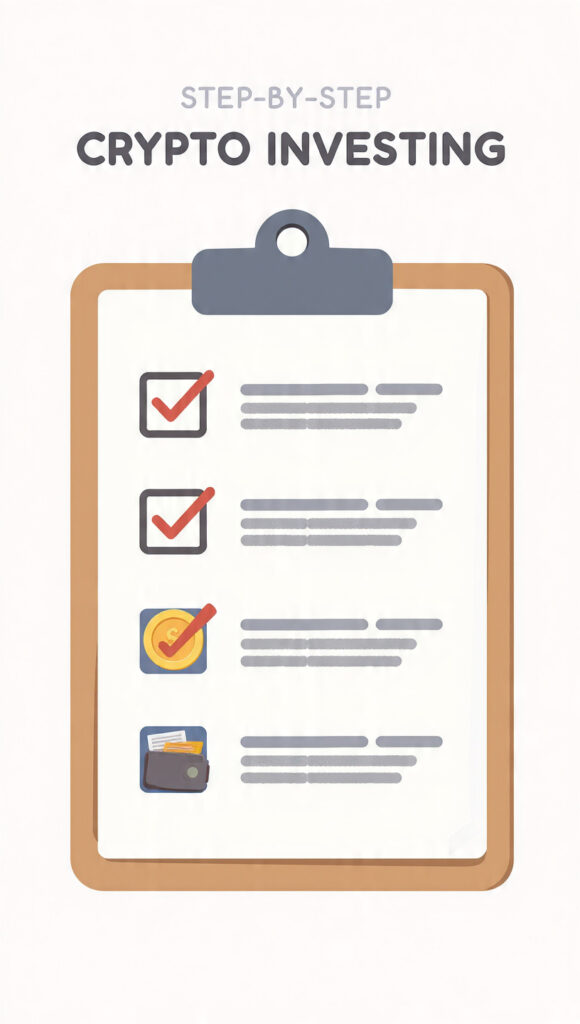
If you decide crypto fits your risk tolerance, here’s a safer way to begin:
- Educate yourself first
- Understand basic terms: wallet, private key, public address, exchange, blockchain.
- Read up on Bitcoin and Ethereum from reliable, neutral sources.
- Choose a reputable, regulated platform
- Prefer exchanges or brokers licensed in your country or region.
- Check:
- How long they’ve been operating
- Security features and insurance policies
- Independent reviews (not just influencer promotions)
- Set up and secure your account
- Use a strong, unique password.
- Turn on two‑factor authentication (2FA) using an authenticator app, not just SMS if possible.
- Be cautious of phishing emails and fake support accounts.
- Start small
- Make a test purchase with a modest amount.
- Practice sending a tiny amount to your own wallet if you plan to self‑custody.
- Decide on custody (where your crypto lives)
- Small amounts: keeping them on a reputable exchange is simpler for beginners.
- Larger amounts / long‑term holdings: consider a hardware wallet with a securely stored recovery phrase.
- Track your investments and transactions
- Use a simple spreadsheet or a crypto portfolio app.
- Make note of:
- Dates
- Amounts
- Buy/sell prices
- Transaction IDs and fees
7. Taxes and Record‑Keeping
In many countries, crypto is treated as taxable property, not just “internet money”.
- Buying and holding often isn’t taxable by itself.
- Selling, swapping, or spending crypto usually creates a taxable event:
- If you sell for more than you paid, you may owe capital gains tax.
- Some jurisdictions also tax:
- Staking rewards
- Mining income
- Airdrops
Because rules differ widely:
- Check your local tax authority guidance.
- Keep detailed records from day one.
- Consider using a crypto tax software tool if you trade often.
Ignoring taxes now can create a much bigger headache later.
8. Avoiding FOMO and Spotting Red Flags
FOMO (fear of missing out) is powerful in crypto. Protect yourself by watching for these red flags:
- Guaranteed returns (“Earn 3% per day risk‑free!”)
- No clear use case or vague whitepapers full of buzzwords
- Anonymous team with no track record or verifiable identity
- Aggressive marketing, countdown timers, or pressure to “buy now”
- Promoters flaunting only luxury lifestyles instead of explaining the tech or risks
- Projects that only grow because new people keep joining or buying in
A simple rule:
If you don’t understand what a project does and how it creates value, don’t invest.
9. Is Crypto Right for You? A Quick Checklist
Before you put money into crypto, ask yourself:
- Do I have a 3–6 month emergency fund in cash or safe assets?
- Have I paid down high‑interest debt (like credit cards)?
- Can I emotionally handle seeing this investment drop 50–80% without panicking?
- Am I willing to read and learn before clicking “buy”?
- Am I okay with the possibility that I may lose all of this money?
If the honest answer to most of these is “no”, it may be too early for you to invest in crypto.
10. Final Thoughts
Crypto, Bitcoin, and blockchain are likely here to stay in some form—but that doesn’t mean everyone should invest, or that it’s right for every situation.
For everyday investors, the sensible approach is:
- Understand the basics before acting
- Start, if at all, with a small, carefully considered allocation
- Focus on security, regulation, and risk management
- Be skeptical of hype, promises of easy money, and social media gurus
If you treat crypto like any other high‑risk asset—with caution, education, and patience—you’ll be in a much better position than those chasing the next quick win.