
If you manage ads on Google, Meta, TikTok, or other platforms, you have already felt the shift toward AI in performance marketing. Smart bidding, automated creatives, broad targeting, Advantage+ campaigns, Performance Max, dynamic search ads, responsive creatives, automated rules, AI copy suggestions—everywhere you look, the tools promise more results with less manual work. At the same time, you might worry about losing control, wasting budget, or becoming just a “button pusher” for black‑box systems.
This guide will help you treat AI in performance marketing as a powerful assistant, not a scary replacement. You will see what AI in performance marketing really means today, where it can genuinely save hours, how to build practical workflows around it, and where you still need a human brain to guide the machine. You will also learn about the most common mistakes teams make when they hand everything over to automation and how to avoid them.
By the end, you should have a clear picture of how to plug AI in performance marketing into your daily work so you spend less time on repetitive tasks and more time on strategy, creative thinking, and talking to real humans.
What AI in Performance Marketing Really Means Today
AI in performance marketing is not one single tool. It is a collection of machine‑learning based features inside ad platforms and external tools that help you optimise budgets, bids, targeting, creatives, and reporting. In practice, you see AI in performance marketing every time you use features like Google’s Smart Bidding, Performance Max, Meta’s Advantage+ campaigns, automated placements, or lookalike audiences built from your data.
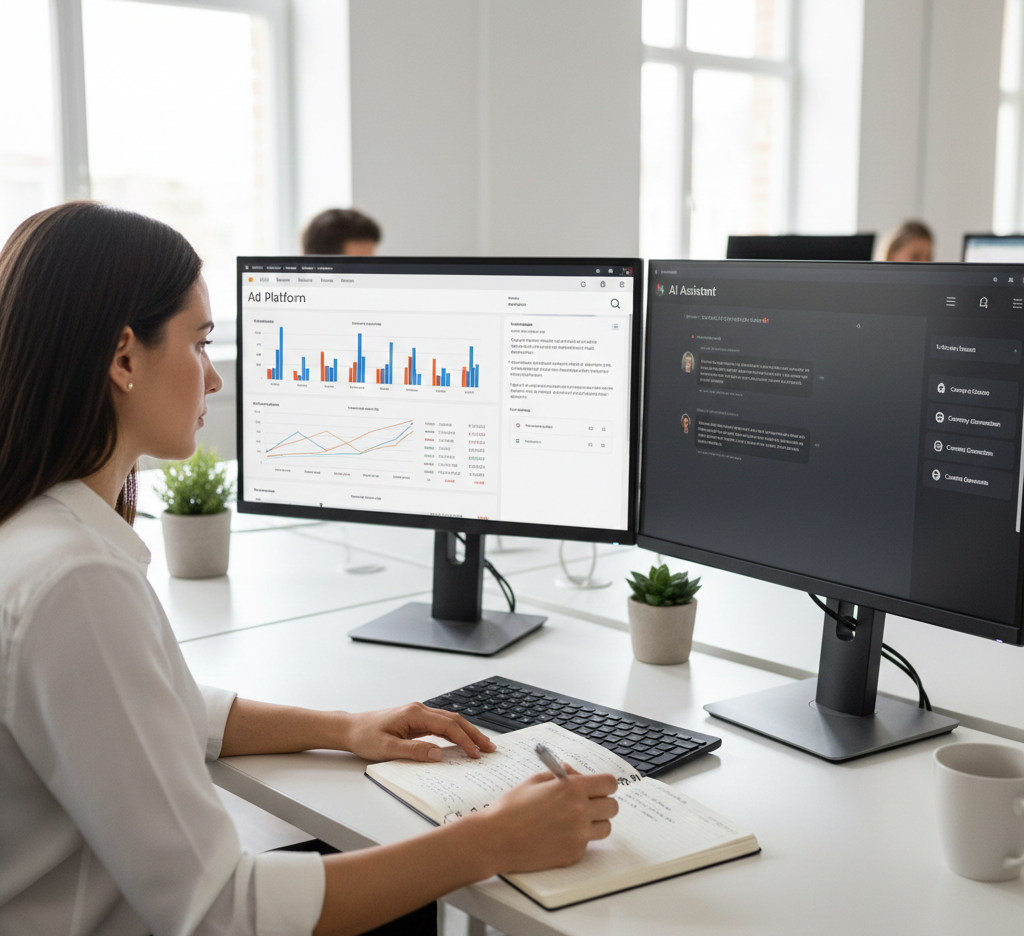
Under the hood, platforms use models trained on billions of data points to predict which impression is more likely to lead to your goal, whether that is a click, lead, purchase, or app install. Instead of you manually setting bids for each keyword or audience segment, AI in performance marketing adjusts bids in real time based on signals like device, location, time of day, audience behaviour, and more.
AI in performance marketing also shows up in creative optimisation. Responsive search ads mix and match headlines and descriptions to find combinations that work. Dynamic product ads choose which items to show which people. Automated A/B testing tools rotate images and copy to learn which creatives perform best for each segment.
Beyond the native platform features, AI in performance marketing is present in scripts, third‑party tools, and language models like ChatGPT that you use to generate copy, structure campaigns, or analyse raw data faster. The key is that AI is no longer a separate “add‑on”; it is woven into nearly every part of modern performance marketing.
Understanding this landscape is the first step. Once you accept that AI in performance marketing is already here to stay, you can decide where to lean into it and where to set firm guardrails.
Why AI in Performance Marketing Matters for Your Results and Your Time
There are two big reasons you should care about AI in performance marketing: efficiency and effectiveness.
On the efficiency side, AI in performance marketing can handle thousands of micro‑decisions per second that would be impossible for a human to manage manually. Instead of spending hours each week changing bids, pausing low‑performing keywords, or moving budget between campaigns, you can let smart bidding and budget automations react in real time. That means less time in spreadsheets and more time thinking about big‑picture questions like positioning, offers, and creative angles.
On the effectiveness side, AI in performance marketing can uncover patterns that you cannot easily see. For example, it might notice that people in a specific region convert better on certain devices at particular times of day, and adjust bids or placements accordingly. When you give the model clear goals and good data, it can squeeze more value out of each impression than a fixed, rules‑based system.
There is also a competitive angle. If your competitors are using AI in performance marketing to test dozens of creatives, optimise across channels, and refine bids continuously, while you are still adjusting everything manually once a week, you are likely leaving performance on the table. Over time, that gap compounds.
At the same time, AI in performance marketing does not remove the need for human insight. The models do not know your margins, supply constraints, brand sensitivity, or long‑term strategy unless you design your structures and inputs to reflect them. The best results come when you let AI do the heavy lifting on execution while you stay in charge of what to test, what success looks like, and how to respond to changes in the wider business.
Core Areas Where AI in Performance Marketing Saves Hours
To use AI in performance marketing well, it helps to break your work into a few core areas and see how automation can help in each one.
One big area is bidding and budgeting. Instead of managing manual CPC bids or rigid rules, you can use smart bidding strategies that optimise for conversions or conversion value. On Google Ads, strategies like Target ROAS and Target CPA described at https://support.google.com/google-ads/answer/6268626 let AI in performance marketing adjust bids dynamically based on auction‑time signals. On Meta, Advantage+ shopping campaigns can automatically allocate budget to the best‑performing ad sets.
Another area is creative optimisation. AI in performance marketing can test many variations of headlines, descriptions, images, and videos faster than you can manually. Responsive search ads, dynamic ad formats, and built‑in creative A/B testing all use machine learning to identify winning combinations. Third‑party tools and language models can also help you brainstorm and refine copy ideas, then you let the platform’s AI handle distribution and rotation.
Audience targeting is also heavily influenced by AI in performance marketing. Lookalike audiences, predictive audiences, and broad targeting with conversion optimisation all lean on AI to decide who should see your ads. Instead of building dozens of micro‑segments, you define a clear goal and high‑quality seed data, then let the system expand reach to similar users.
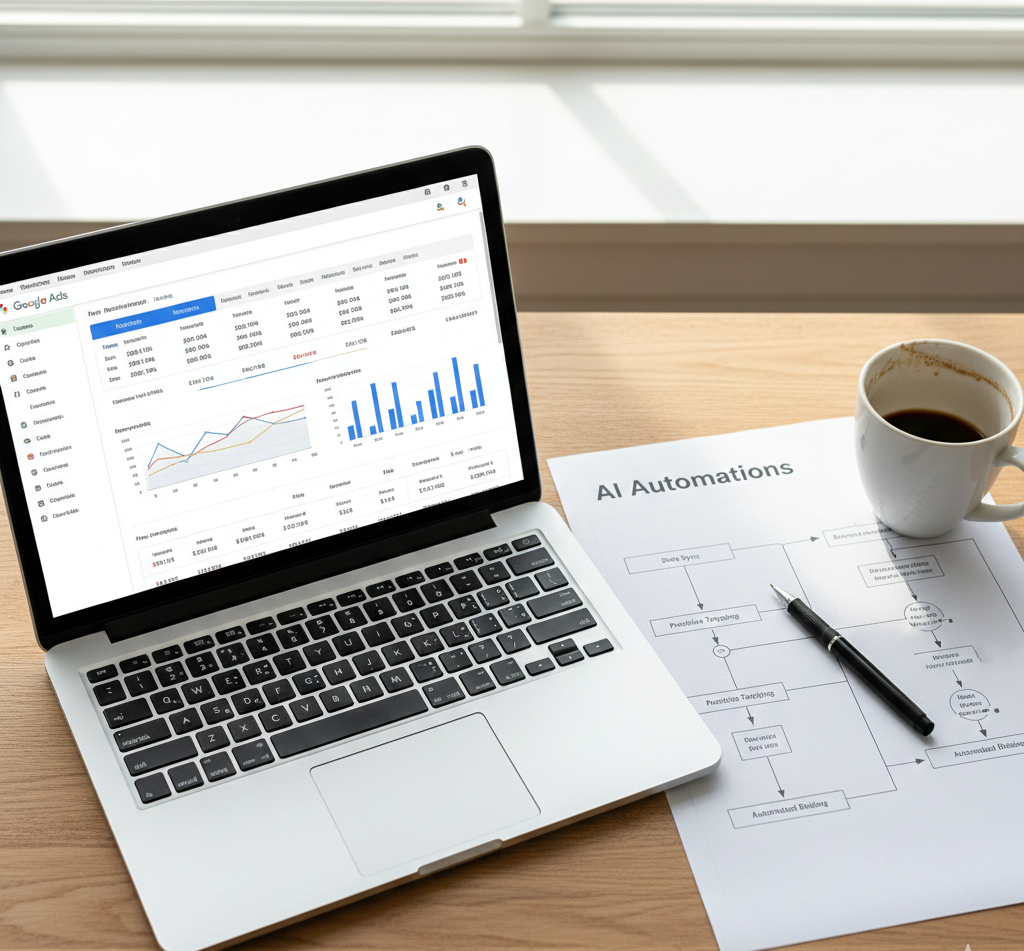
Reporting and analysis is a fourth major area. AI in performance marketing can help you surface trends, anomalies, and insights in large datasets. Automated alerts can tell you when performance suddenly drops on a key campaign. Scripts and BI tools can pull data from multiple platforms, clean it, and generate dashboards that focus on real business KPIs rather than vanity metrics.
Workflow management is a fifth area. You can use AI‑assisted tools to generate campaign structures, naming conventions, and UTM schemas, then use scripts or APIs to create or pause campaigns according to rules you define. Instead of clicking around interfaces repeatedly, you turn routine actions into automated workflows that reflect your strategy.
Once you see these areas clearly, you can start mapping your current tasks and asking where AI in performance marketing can reduce manual effort without sacrificing control.
Building Practical Workflows with AI in Performance Marketing
It is one thing to know that AI in performance marketing exists; it is another to build daily routines around it. The goal is not to automate everything blindly, but to design workflows where AI handles repeatable tasks while you focus on strategy and creative thinking.
A good starting point is your planning phase. Before launching new campaigns, use language models to speed up research and ideation. You can ask an AI assistant to suggest keyword clusters, audience pain points, or headline variations based on your brief. You still need to edit and filter heavily, but AI in performance marketing can turn a blank page into a structured starting point faster.
Next, in the setup phase, lean on automated campaign types where they make sense. For example, you might use Google’s Performance Max campaigns for ecommerce or multi‑signal conversion goals, while still running some standard search or shopping campaigns where you need tighter control. Meta’s Advantage+ shopping or app campaigns can sit alongside more granular ad sets. The key is to define clear business goals and give AI in performance marketing enough data and budget to learn.
In the optimisation phase, design a weekly loop where AI does the micro‑adjustments and you do the macro‑decisions. Smart bidding and automated placements fine‑tune delivery, while you look at query reports, creative fatigue, offer relevance, and landing page performance. You might decide to feed better negative keywords, refresh creatives, or change your value tracking to give AI in performance marketing cleaner signals.
In reporting, connect your ad platforms to an analytics tool or data studio where AI‑powered visualisations can highlight anomalies and patterns. Tools that integrate Google Analytics 4, ad platforms, and CRM data can show you full‑funnel performance without you exporting CSVs every morning. The more you can standardise naming conventions and conversion tracking, the more reliable your AI in performance marketing insights become.
Finally, in communication, use AI‑assisted drafting to speed up internal and client updates. You can feed key metrics and observations into a language model and ask it to generate a first draft of your weekly performance summary. You then correct, add context, and adjust tone, but you save time on structure and wording.
When you design your day around these loops, you begin to feel how AI in performance marketing can genuinely free up mental space, as long as you stay in the driver’s seat.
Guardrails You Need Around AI in Performance Marketing
Because AI in performance marketing is powerful, it needs boundaries. Without clear guardrails, it can optimise for the wrong things, overspend, or move your account in directions that do not match your business reality.
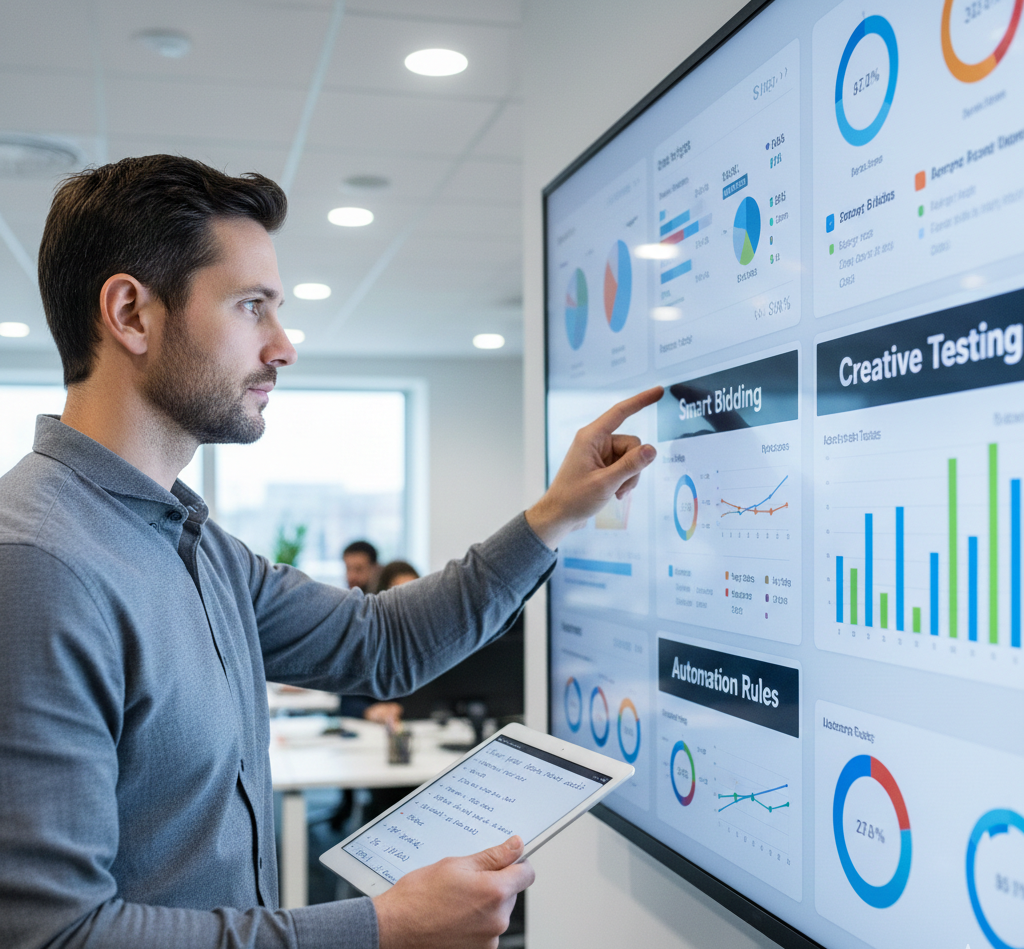
One essential guardrail is clean, accurate conversion tracking. If your data is broken, delayed, or full of noise events, AI in performance marketing will happily optimise toward the wrong signals. Before you turn on any smart bidding or broad targeting, audit your tracking. Make sure your primary conversions reflect true value events, like purchases, qualified leads, or meaningful in‑app actions, not just page views or button clicks.
Another guardrail is minimum data thresholds. AI in performance marketing performs best when it sees enough conversions per week to learn. If your volume is very low, relying fully on automated bidding or black‑box campaigns can lead to unstable performance. In those cases, you may need to start with more manual control, aggregate smaller campaigns into larger ones, or focus on upper‑funnel optimisation until you have more data.
Budget caps and pacing rules are also important. Even with smart bidding, you should define clear daily or lifetime budgets for campaigns, especially during testing phases. Automated rules or scripts can pause campaigns that suddenly overspend or underperform according to thresholds you define. This is where tools like Google Ads scripts at https://developers.google.com/google-ads/scripts/docs/features/intro and Meta’s automated rules at https://www.facebook.com/business/help can support your AI in performance marketing strategy.
You also need qualitative guardrails. AI in performance marketing does not understand your brand tone, legal restrictions, or ethical lines unless you tell it. When using automated creative suggestions or broad placements, regularly review where your ads appear and what they say. Exclude sensitive categories, add placement exclusions where needed, and maintain manual oversight on copy that touches regulated topics.
Finally, educate stakeholders. Clients or managers might hear “AI” and expect instant miracles. Be clear that AI in performance marketing needs testing time, good data, and realistic goals. Set expectations around learning periods and the ongoing human work still required.
Common Mistakes Marketers Make with AI in Performance Marketing
As you bring more AI in performance marketing into your workflow, it helps to be aware of mistakes that can quietly hurt performance.
One mistake is switching too fast between strategies. If you launch smart bidding or a new automated campaign type and then change goals, budgets, and structures every few days, the model never has time to stabilise. AI in performance marketing needs consistent conditions to learn. Rapid, random changes reset learning and create noisy results that are hard to interpret.
Another mistake is layering too many controls on top of automation. For example, combining smart bidding with very tight manual bid caps, limited audiences, and strict placement exclusions can suffocate the system. You think you are being safe, but you are actually preventing AI in performance marketing from exploring and finding cheaper conversions in unexpected places.
Over‑trusting platform recommendations is another risk. Google Ads and Meta will happily suggest broadening targeting, increasing budgets, or turning on more automation. Sometimes these suggestions are helpful; other times they mainly benefit the platform’s revenue. You should treat them as ideas to test, not instructions to follow blindly.
Some marketers also rely too heavily on AI‑generated copy and creatives without tailoring. If every ad in your account looks like a generic template, you will blend into the noise. AI in performance marketing works best when you feed it distinct, thoughtful creative concepts. Use AI to brainstorm and refine, but make sure your final assets still sound and look like your brand.
Finally, many teams neglect their own skills. They assume that because AI in performance marketing can “optimise,” they no longer need to understand fundamentals like auction dynamics, quality score, creative fatigue, or measurement. In reality, the more you know, the better you can diagnose when automation goes wrong and design experiments that teach the model useful things. If you feel gaps in your broader skill set, connecting your AI knowledge with a bigger learning path such as Roadmap to Become a Full Stack Digital Marketer in 6–12 Months can help you stay rounded instead of narrow.
How to Stay in Control as AI in Performance Marketing Evolves
AI in performance marketing will keep changing. New campaign types, smarter bidding, more automation, and tighter privacy rules will all shift how much data you see and how much direct control you have. The challenge is to stay adaptable without feeling like the platforms are driving you instead of the other way around.
One way to stay in control is to focus on first‑principles thinking. Remember that behind every fancy AI feature, there is still a basic equation: impressions, clicks, conversions, revenue, and cost. If a new tool cannot improve one of those in a way that matches your business model, it is not valuable, no matter how advanced it sounds.
Another way is to keep testing in a disciplined way. Set up controlled experiments where you compare AI‑heavy setups to more manual baselines. Define clear success metrics and timeframes. Document your learnings. Over time, you will build your own internal playbook for AI in performance marketing instead of relying on generic advice.
You should also stay close to your analytics and CRM. As privacy changes reduce the visibility of user‑level data in ad platforms, your own first‑party data becomes more important. Knowing which leads actually turned into customers, what their lifetime value is, and how they behave post‑click lets you feed better signals back into AI in performance marketing, whether through value rules, offline conversion imports, or custom audiences.

Finally, invest in your own learning. Follow official documentation, trusted blogs, and communities where experienced performance marketers share real case studies rather than hype. The marketers who thrive will not be the ones who know every new feature name; they will be the ones who understand how to align AI in performance marketing with real business outcomes.
Final Thoughts: Using AI in Performance Marketing as Your Co‑Pilot
AI in performance marketing is not going away. If anything, it will become more central to how campaigns are built, delivered, and measured. You can choose to fight it, ignore it, or learn to work with it. Only the last option keeps you relevant and opens up new opportunities.
You have seen what AI in performance marketing really is, why it matters for both results and time, where it can save you hours, what guardrails you need, and which mistakes to avoid. You have also seen how to design practical workflows where AI handles the repetitive optimisation while you stay in charge of goals, strategy, creative concepts, and measurement.
If you treat AI in performance marketing as a powerful co‑pilot rather than an autopilot, you can free yourself from low‑value busywork and spend more of your energy on the parts of marketing that machines cannot replace: understanding humans, crafting stories, and making smart decisions when the data is noisy. That is where your real value will always live.
FAQ: AI in Performance Marketing
Do I have to switch everything to AI right now?
No. You can gradually test AI in performance marketing on selected campaigns or account segments. Start where you have enough data and clear goals, then expand when you see consistent improvements.
Is manual bidding completely dead?
Manual bidding is less common now, but it is not dead. It can still be useful in low‑volume situations, niche campaigns, or special cases where smart bidding does not have enough data. However, for many mainstream scenarios, automated bidding is becoming the default.
Will AI in performance marketing take my job?
AI will change your job more than remove it. Routine optimisations will be handled by machines, but humans will still be needed for strategy, creative direction, testing design, and cross‑channel thinking. Marketers who learn to guide AI in performance marketing will be in high demand.
How much data do I need before using smart bidding?
Most platforms recommend at least a few dozen conversions per month per campaign or portfolio for stable performance. The exact number varies, but the more consistent, high‑quality conversion data you can feed into AI in performance marketing, the better it will work.
Can I trust platform recommendations about automation?
Platform recommendations can be useful starting points, but they are not always aligned perfectly with your goals. Test them with experiments, monitor results closely, and keep your own judgment active. AI in performance marketing is a tool, not a boss.