
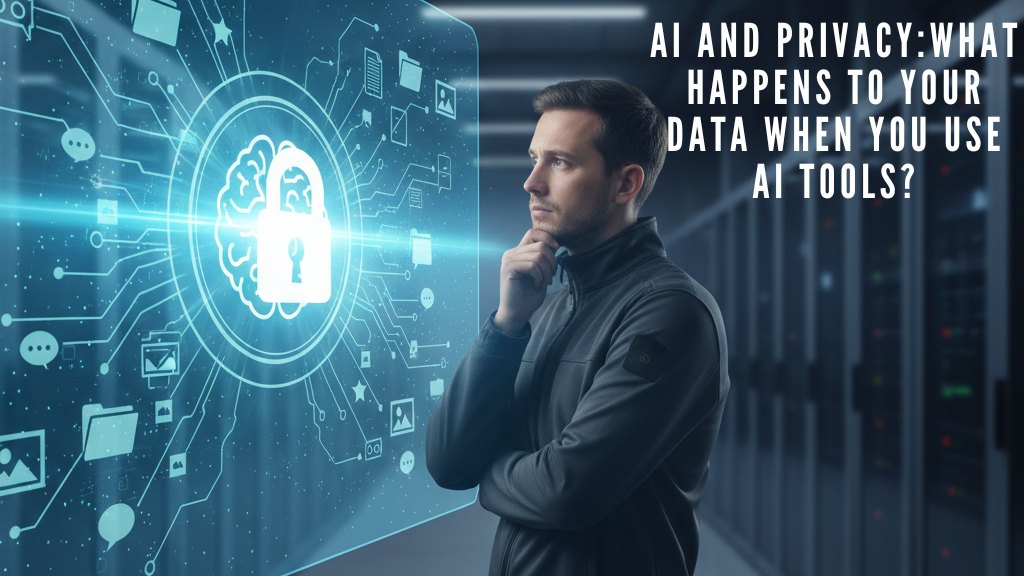
If you use chatbots, image generators, smart assistants, or “magic” writing tools, you have probably wondered about AI and privacy at least once. You might ask yourself whether these apps are saving everything you type, who can see your conversations, and what really happens to your data behind the scenes. With so much hype around AI, it is easy to feel excited and worried at the same time.
In this guide, you will see AI and privacy in simple, human language. You will learn what actually happens to your data when you use popular AI tools, why companies want that data, what the real risks are, and how you can protect yourself without having to give up all the benefits of modern technology. You do not need to be a tech expert to understand AI and privacy; you just need clear explanations and a few good habits.
By the end, you should feel less confused and more in control whenever you open an AI app, type a prompt, or upload a file.
What AI and Privacy Really Mean in Everyday Life
Before you can make smart decisions, you need to understand what AI and privacy actually mean together. Artificial intelligence, in this context, usually refers to software that learns from large amounts of data to generate text, images, audio, recommendations, or decisions. Privacy is about who has access to information about you, what they do with it, and how much control you have.

When you use an AI tool, you are almost always sharing some kind of data. It might be obvious, like the text you type into a chatbot, the photos you upload to an image editor, or the voice commands you give to a smart speaker. It might also be less obvious, like your device type, location, usage patterns, or how long you spend on each feature. All of this sits at the intersection of AI and privacy.
AI systems need data to work well. They are trained on huge datasets so they can recognise patterns in language, images, or behaviour. Some tools also use your ongoing interactions to improve their models or personalise your experience. This is where AI and privacy become complicated. On one hand, more data can mean better results for users. On the other hand, more data also means more potential for misuse, leaks, or tracking.
AI and privacy are not only about secret hacking or dramatic scandals. Most of the time, the way your data is handled is described in long, boring privacy policies and terms of service that almost no one reads. The challenge is that important details about AI and privacy are often hidden in that small print.
Why AI and Privacy Matter More Than Ever
You might feel that AI and privacy are issues only big companies, lawyers, or governments need to worry about. In reality, they affect your daily life in many small but important ways.
First, AI and privacy shape how much control you have over your own information. If you do not know what an app does with your data, you cannot decide whether you are comfortable using it. You might be sharing sensitive text, images of family members, or copies of important documents without realising how widely they could travel inside a company’s systems.
Second, AI and privacy influence your safety. Data collected today can be used in new ways tomorrow. For example, information about your location, habits, or financial situation could become a target for criminals if it is not properly protected. Voice clones, deepfakes, and personalised phishing emails are all easier to create when there is a lot of data about you floating around.
Third, AI and privacy matter for your dignity and autonomy. If AI tools silently collect and analyse your behaviour, they can be used to profile you, predict your choices, or nudge you in certain directions. This might show up as ads that feel too personal, recommendations that trap you in one viewpoint, or offers that exploit your weaknesses. Without transparency, AI and privacy issues can quietly limit your freedom.
Finally, AI and privacy are connected to trust. When companies handle your data carefully, explain clearly, and give you control, trust grows. When they hide practices, suffer repeated breaches, or use your data in ways you did not expect, trust collapses. That broken trust makes people either avoid useful tools or use them with constant fear.
Understanding AI and privacy helps you make calmer, wiser choices about which tools to adopt, which to avoid, and how to set boundaries.
What Actually Happens to Your Data in AI Tools
To really understand AI and privacy, it helps to walk through what usually happens to your data when you use different types of tools. Exact behaviour varies by company, but there are common patterns you should know.
When you use a text-based AI assistant, the words you type are sent from your device to the company’s servers. There, the AI model processes your prompt and generates a response, which is then sent back to you. In many cases, the company may log your input and output for a period of time. They might use this data to monitor abuse, fix bugs, prevent misuse, or improve the model. Some providers allow you to opt out of having your data used for training; others do not, or only for paid plans. This is a core AI and privacy issue.
With image or video tools, the files you upload are usually stored temporarily on servers while processing happens. Some services delete files quickly; others may keep them longer for quality control or model training. If you are dealing with photos of children, confidential documents, or personal ID, AI and privacy questions become more serious, because a leak could be very harmful.
Productivity apps with built‑in AI, such as email, note, or document tools, often combine your content with metadata like time, collaborators, and device details. This mix of information can make your experience smoother—for example, smarter suggestions or search—but it also enlarges the pool of data companies hold about you. That is another layer in AI and privacy to keep in mind.
Behind the scenes, companies may share some data with third parties. This can include cloud providers, analytics services, or integrated partners. Good providers will explain this in their privacy policies and follow regulations like the GDPR in Europe, which is described in plain language at https://gdpr.eu/what-is-gdpr/. Weak or shady providers may be vague, collect more than they need, or sell data for advertising in ways that stretch the limits of AI and privacy ethics.
It is also important to understand that many AI tools anonymise or aggregate data. This means your individual prompts might be stripped of obvious identifiers and mixed with others. While this reduces some risks, it does not remove them entirely, especially if the original content contained sensitive details that could be re‑identified.
Knowing these patterns lets you ask better questions before you trust any tool with your data.
The Main Risks Around AI and Privacy
Not every AI and privacy risk is equally likely or dangerous, but it is useful to understand the main categories so you can spot them.
One risk is data breaches. If a company storing your prompts, images, or documents is hacked, that information can leak. This is not unique to AI, but because AI tools often collect rich, detailed content, the impact can be greater. Sensitive health, financial, or legal details typed into a chatbot could become public if security fails.
Another risk is misuse from the inside. Employees at a company could access logs, training datasets, or internal tools that include user content. Responsible firms limit this access and audit it, but AI and privacy scandals have shown that not all organisations follow best practices. The more sensitive your data, the more cautious you should be.
A subtler risk is secondary use. You might use an AI app for one purpose, like editing a resume, but the company could reuse your content to train a model for another purpose or share insights with partners. If you did not fully understand this when you clicked “accept,” AI and privacy problems appear later, when you realise how far your data has travelled.
There is also the risk of profiling. AI systems can analyse large amounts of data about your behaviour to guess your interests, fears, and likely choices. This can lead to more targeted advertising, but in extreme cases it can also lead to discrimination or manipulation. For example, people might be shown different prices, offers, or news based on AI‑driven profiles they never see. This is a deep AI and privacy concern that regulators are just beginning to handle.
Finally, there are reputational and emotional risks. If intimate conversations or personal images are ever exposed, the damage can be deeply personal. Even the fear of this happening can make people anxious about using tools that could otherwise help them.
None of this means you must avoid AI completely. It means you should treat AI and privacy as seriously as you treat locking your front door or protecting your bank PIN.
How to Protect Yourself: Practical AI and Privacy Habits
The good news is that you can reduce many AI and privacy risks with a few simple, consistent habits. You do not need to become paranoid; you just need to become more intentional.
Start by being careful with what you share. Before you paste something into an AI tool, pause and ask whether it contains information you would be uncomfortable seeing exposed publicly or stored long term. This includes full names, addresses, phone numbers, passwords, ID documents, confidential work files, or private health details. If you must work with sensitive content, consider anonymising it first by removing or changing identifying details. This one habit dramatically improves your AI and privacy situation.
Next, choose providers thoughtfully. Not all AI tools are equal. Look for companies that publish clear privacy policies, explain how long they keep data, and offer settings to restrict training or logging. Large, regulated companies are not perfect, but they usually have more to lose from mishandling AI and privacy than small, unknown apps that appear overnight and disappear just as fast. The US Federal Trade Commission’s guidance on privacy and data security at https://www.ftc.gov/business-guidance/privacy-security gives an idea of what responsible handling looks like.
Person looking at digital icons of data flowing into an AI brain with a lock symbol, representing AI and privacy concerns.”Make a habit of checking privacy settings. Many apps allow you to clear histories, disable personalised ads, or opt out of data being used to improve models. These options are often hidden under “Settings” or “Privacy,” but they are worth finding. Adjusting them once can improve your AI and privacy posture for months.
If you use AI at work or school, ask questions about policies. Find out whether your organisation allows you to paste internal information into external AI tools, whether they provide approved tools, and how they handle logs. If no policy exists yet, that is a sign that your team needs to think more about AI and privacy before relying heavily on these tools. Linking your awareness of risk with a broader understanding of threats, such as those described in Dark Side of AI: 7 Alarming Risks & How to Respond, can help you have more informed conversations.
Finally, keep your accounts secure. Strong, unique passwords and two‑factor authentication are basic but powerful protections. AI and privacy breaches are often made worse when attackers can easily log into accounts and see everything from the inside.

Common Mistakes People Make About AI and Privacy
Even smart, careful people make predictable mistakes with AI and privacy, mostly because these tools feel friendly and harmless on the surface.
One common mistake is treating AI chats like private diaries. People pour out feelings, secrets, and detailed stories to chatbots because they feel non‑judgmental. While the emotional relief is real, the AI and privacy risk is that these words may be stored, reviewed, or used for training. You should always assume that anything you type into a cloud‑based system could, in theory, be seen by a human at some point.
Another mistake is trusting brand names too much. Just because a company is famous or has a nice design does not mean its AI and privacy practices are perfect. Big companies have been fined under regulations like the GDPR for mishandling data. Brand reputation is one factor, but it is not the only one.
Some people go the other way and assume all AI and privacy risks are equal. They avoid using helpful tools for basic tasks like summarising public articles or drafting generic emails because they fear any use is dangerous. In reality, there is a huge difference between pasting your passport into a random app and using AI to rephrase non‑sensitive text. Learning to distinguish low‑risk from high‑risk uses is part of becoming mature about AI and privacy.
Another trap is ignoring updates. Privacy policies and settings can change as tools evolve. If you never revisit them, you might miss new options to protect your data or new clauses that expand how your content can be used. Skimming update emails or checking settings occasionally keeps you aligned with your AI and privacy preferences.
Finally, many people never talk about AI and privacy with friends, family, or colleagues. They quietly worry or quietly ignore the topic. Open conversations can spread good habits, reduce shame when people make mistakes, and put pressure on companies and institutions to handle AI and privacy more responsibly.
Final Thoughts: Staying Smart About AI and Privacy
AI is becoming part of almost every area of life, from how you search for information to how you write, design, shop, and even relax. That makes AI and privacy too important to ignore. But it also means fear alone is not a good long‑term strategy. You need a balanced approach that lets you benefit from AI while still protecting your data and your dignity.
You have seen what really happens to your data in AI tools, why companies collect it, what the main risks are, and how a few calm, practical habits can reduce those risks. You have also seen common mistakes that even experienced users make when they forget to think about AI and privacy until something goes wrong.
If you stay curious, ask questions, and treat your personal information with care, you do not have to feel powerless. You can decide which tools deserve your trust, which do not, and how far you are willing to go with each. In a world where AI and privacy are constantly evolving, that kind of awareness is one of the most important skills you can build.
FAQ: AI and Privacy
Are AI tools always storing and using everything I type?
Not always, but many cloud-based tools log your interactions for at least some time. Some allow you to disable training on your data or clear histories. To understand AI and privacy for a specific app, you need to read its privacy policy and check its settings.
Is it safe to use AI for work documents?
It depends on the sensitivity of the documents and your organisation’s rules. Highly confidential or regulated information should usually not be pasted into external AI tools unless your company has approved a specific, secure system. Always check internal policies before mixing AI and privacy in a work context.
Can AI see my identity even if I do not type my name?
AI systems may not know your real-world name from a single chat, but they can still link your activity to an account, device, or IP address. Over time, patterns can reveal a lot about you, which is why AI and privacy are still important even when you do not share obvious identifiers.
What should I never share with AI tools?
You should avoid sharing passwords, PINs, full ID numbers, highly sensitive medical or legal details, and any information that would seriously harm you if it became public. Treat AI chats like emails to a semi‑trusted colleague, not like a locked diary.
Will AI and privacy rules get stronger in the future?
Many experts expect stronger regulations as governments catch up with technology. Laws like the GDPR were early steps, and new AI‑specific rules are being discussed in several regions. However, laws take time to develop, so your personal habits around AI and privacy will always be an important first line of defence.