

If you are a working student trying to juggle classes, a job, and bills, the idea of building a side income online might feel both exciting and scary. You probably want that extra money for fees, rent, or savings, but you are also worried about burning out or letting your studies suffer. The good news is that side income online is possible even with a busy schedule, as long as you choose realistic options and follow a clear plan.
In this guide, you will learn what side income online really means for working students, why it can be a smart move for your education and career, and how to start step by step without overwhelming yourself. We will talk about practical online income ideas, how to get your first small client or sale, and the most common mistakes to avoid. Think of this as a friendly roadmap, not a get-rich-quick promise.
Whether you are working part-time, full-time, or doing shifts on weekends, you can still create a flexible income stream online that fits into your life instead of destroying it.
What Side Income Online Really Means
When you hear the phrase side income online, you might imagine instant success, passive income, and people making huge amounts of money while barely working. That is not the reality for most working students, and it is important to start from a honest definition.
Side income online simply means earning extra money using the internet in addition to your main job or studies. It could be freelancing, tutoring, content creation, virtual assistance, selling digital products, or doing remote tasks for companies. Sometimes you are paid per hour, sometimes per project, and sometimes based on views or sales.
The key word is “side.” This is not your main job right now. It is a flexible income stream that you can build slowly. At first it might only cover your phone bill or a small part of your rent. Over time, if you stay consistent and improve your skills, it can grow into something more serious, like a part-time business or the base for a future full-time career.
Side income online is also different from random online scams or risky schemes. If something promises huge money with no skills and no effort, it is usually not worth your time. Real side income might start small, but you are learning skills, building a portfolio, and creating long-term opportunities for yourself.
Why Side Income Online Matters for Working Students
You may already have a job while studying, so you might wonder if you really need side income online on top of that. The answer depends on your situation, but there are several reasons why it can be valuable.
First, the extra money can relieve financial pressure. Even a modest side income can help you avoid high-interest debt, reduce stress about monthly expenses, and give you some breathing space. When you are not constantly worrying about money, it becomes easier to focus in class and perform better at work.
Second, the right kind of side income online helps you learn real-world skills that you will use in your future career. For example, if you do freelance design, writing, tutoring, or digital marketing, you are not only earning money, you are also building a portfolio and gaining experience that looks great on your CV. If you want to improve it, read my guide Resume Tips for Freshers: Write a CV That Gets Noticed
Third, online income gives you flexibility that many offline part-time jobs cannot. You might be able to choose your own working hours, work from home, and stop or reduce your workload during exams. This flexibility can be a game changer for working students who have unpredictable schedules.
Finally, side income online can increase your confidence. When you earn money using your skills instead of just trading time for a fixed wage, you start to see your potential differently. You realise you can create opportunities for yourself instead of just waiting for them.
How to Choose the Right Side Income Online for You
Not every online income idea is right for every working student. The best option for you depends on your skills, interests, time, and energy levels. Before you jump in, you should take a moment to think about what actually fits your life.
Start by looking at your current skills and strengths. Maybe you are good at explaining concepts to friends, which makes you a natural fit for online tutoring. Maybe you enjoy writing, graphic design, or editing videos. Maybe you are organised and like helping people manage tasks, which could lead to virtual assistant work.
Next, be honest about your schedule. If you are already working long shifts plus studying, you may not have hours every day to invest. In that case, choose something that can be done in short, focused sessions, like freelancing on specific projects, doing microtasks, or creating content in batches once or twice a week.
You should also think about your goals. Are you trying to make quick money for short-term expenses, or are you more interested in building skills for a future career? If you want quick income, you might start with simpler tasks that pay immediately. If you care about long-term growth, you might accept slower early earnings while you learn higher-value skills, such as digital marketing or web design. Here you can link to a post about a roadmap to become a full stack digital marketer.
Finally, consider how much mental energy you have left after work and classes. It is better to pick a side income online that feels at least somewhat enjoyable, rather than something that drains you completely. When you like what you are doing, it is easier to stay consistent over months, not just days.
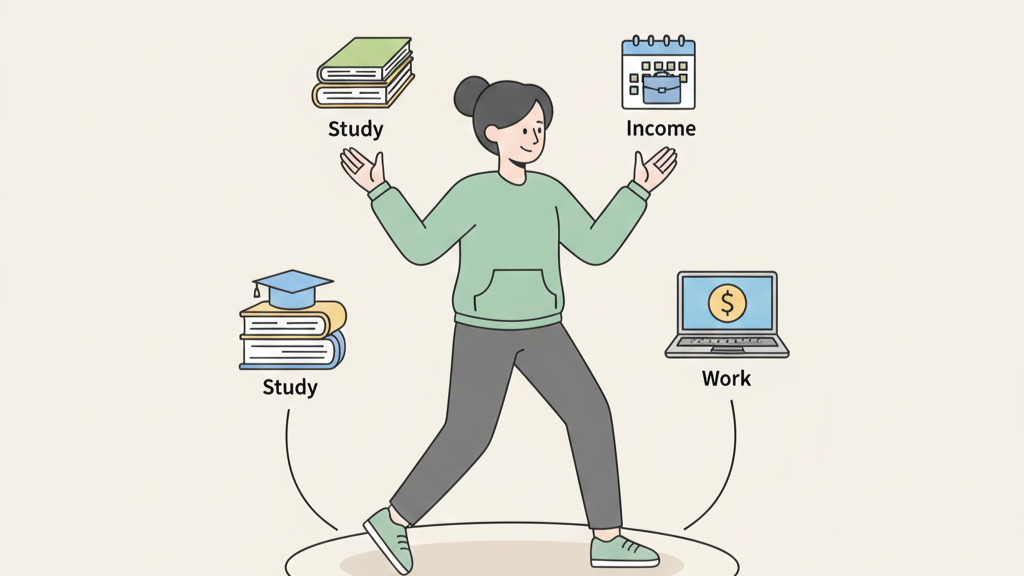
A Practical Roadmap to Start Earning Online While Studying and Working
Instead of trying random ideas, it helps to follow a simple roadmap. You do not have to follow these steps in a perfect order, but they give you a clear direction.
Clarify Your Time, Energy, and Income Goals
Before you sign up for any platform or say yes to any client, sit down with a piece of paper or a notes app. Ask yourself how many hours per week you can safely dedicate to side income online without harming your studies or your main job. Maybe it is five hours, maybe ten. Be realistic, not overly optimistic.
Then, decide why you want this extra income. Are you trying to cover a fixed monthly amount, like a loan instalment or rent? Are you saving for something specific, like a laptop or a course? Having clear goals helps you stay motivated when you feel tired after a long day.
Also pay attention to your energy pattern. Some working students function best late at night, others prefer early mornings or weekends. Plan your side work for those times when you can actually focus, not when you are half asleep.
Pick One Main Online Income Path to Test
At the beginning, it is tempting to try everything at once. You might sign up for freelancing sites, survey sites, teaching platforms, and start a YouTube channel all in the same week. This usually leads to frustration and no real progress.
Instead, choose one main path to test for the next one or two months. For example, you might decide to focus on freelance writing and content creation. Or you might pick online tutoring, or virtual assistant work, or selling digital notes and templates. During this time, you commit to learning about that path and taking small but consistent actions.
If you choose freelancing, you might explore platforms like Upwork at https://www.upwork.com or Fiverr at https://www.fiverr.com/, as well as reaching out directly on LinkedIn. If you choose tutoring, you can look at online tutoring platforms in your region or even tutor peers and younger students privately using video calls.
By focusing on one path first, you give yourself a real chance to see results instead of constantly starting over.
Set Up Your Basic Online Presence
Even as a beginner, you should set up a simple, professional online presence. This does not mean you need a fancy website immediately, but you should have a place where people can see who you are and what you offer.
For many working students, a well-optimised LinkedIn profile is a great starting point. Use a clear photo, write a short summary about your studies, your current job, and the side income online services you provide. Mention your skills, such as writing, design, tutoring, or admin support, and ask friends or classmates for recommendations if they have seen your work.
You can also create simple portfolios using free tools like Google Docs, Notion, or a basic website builder. Show examples of your work: sample articles, designs, lesson plans, or task lists. If you do not have client work yet, create mock projects that look realistic.
Having this basic presence makes it easier to send potential clients or students a link instead of trying to explain everything in long messages.
Get Your First Small Client or Sale
The first client or sale is the hardest, but once you get it, your confidence grows. Start small and be willing to learn. You do not need to charge high rates at the beginning, especially if you are still gaining experience.
You can start by offering your services to people you already know. Maybe a colleague at your main job needs help managing their social media. Maybe a classmate’s younger sibling needs online tutoring. Maybe a local business needs someone to update their website or handle simple admin tasks. Let people know clearly what you can help with.
You can also apply for small gigs on freelancing platforms or job boards. When you do, write short, specific proposals instead of copying the same text everywhere. Show that you read the client’s description and explain briefly how you would solve their problem.
Even if your first project is small and not perfectly paid, treat it seriously. Deliver on time, communicate well, and ask for feedback or a testimonial afterwards. This is how you start building your reputation.
Build a Routine Around Your Studies and Work
Once you start earning, you need to protect your health and your grades. Many working students get excited about side income online and then overload themselves, which ends up hurting their main priorities.
Create a weekly routine where you block specific time slots for side work. For example, you might reserve two evenings and a chunk of time on Sunday. During exams or peak work seasons, you reduce or pause side projects on purpose. When you plan this in advance, you feel more in control.
Also build small systems to save time. Use templates for emails, invoices, and proposals. Use simple task managers or calendar reminders to keep track of deadlines. The more you systemise, the less mental energy each project takes.
Over time, you will find a rhythm where your studies, job, and side income online can coexist without constant chaos.

Popular Side Income Online Ideas for Working Students
There are many ways to earn online, but some are especially suitable for working students.
Freelancing with Skills You Already Have
If you have skills like writing, graphic design, video editing, translation, data entry, or basic digital marketing, freelancing can be a good option. You can offer services on platforms such as Upwork and Fiverr, or directly through LinkedIn and email.
Start by choosing a small set of services instead of offering everything. For example, “blog writing for small businesses” or “short video editing for social media” is more focused than “I can do anything.” As you complete projects, you can gradually increase your rates.
Freelancing does have competition, but if you focus on quality, clear communication, and reliable delivery, you will slowly attract better clients.
Online Tutoring and Academic Support
If you are strong in certain subjects, languages, or test preparation, online tutoring can be a natural fit. Working students often forget that the things they find easy might be hard for others. You can help school students, college juniors, or even people learning your native language.
You can join online tutoring platforms in your region, post in student groups, or use your personal network. For younger students, you might need to adjust your schedule to evenings or weekends, but this often fits nicely around your own classes and job.
Academic support can also include editing assignments, summarising notes, or explaining concepts through recorded videos. Make sure you respect your institution’s rules about plagiarism and academic honesty.
Content Creation and Digital Products
If you enjoy creating content, you can build an audience over time and monetise through ads, sponsorships, or digital products. This path is slower at the beginning, but it can become powerful in the long term.
You might start a YouTube channel, blog, Instagram page, or TikTok account around a topic you care about, such as study tips, productivity, fitness, finance, or coding. As your audience grows, you can create digital products like e-books, templates, or online workshops.
This is not the fastest way to earn, but it can be combined with other side income online methods. For example, a student who shares study tips might eventually sell digital planners, notes, or one-on-one coaching sessions.
Remote Part-Time Customer Support or Virtual Assistance
Many companies now hire remote part-time customer support staff or virtual assistants. These roles often involve answering emails, handling chat support, scheduling, or basic admin tasks.
For working students, these roles can be attractive because they sometimes offer flexible shifts. However, they can also be demanding, especially if they require fixed hours in specific time zones. Always check if the schedule is compatible with your classes and your main job before accepting.
If you are organised, polite, and comfortable using different online tools, you can grow in these roles and later move into operations, support leadership, or project management.
Microtasks and Surveys: When They Make Sense
You will find many websites offering microtasks, online surveys, data tagging, or simple transcription work. These can be okay for very small extra income, especially if you have random free minutes that are hard to use for deep work.

However, the pay is usually low, and these tasks rarely help you build strong skills or a portfolio. If you use them, consider them a short-term option while you work on developing more valuable side income online paths in the background.
Whenever possible, prioritise work that helps you grow skills, not just earn a few quick dollars.
Common Mistakes Working Students Make with Side Income Online
Knowing what to avoid is as important as knowing what to do.
One big mistake is underestimating time and energy. It is easy to say yes to every opportunity and then realise you cannot keep up. When that happens, your grades drop, your main job suffers, and you feel exhausted. It is better to take fewer projects and deliver them well.
Another mistake is jumping from idea to idea too quickly. You might try freelancing for one week, then giving up because you did not get a client, then switching to YouTube, then to tutoring. Every path needs time and consistent effort before it shows results. If you keep restarting, you never reach that point.
Many working students also ignore skill-building. They focus only on making money right now and never invest time in getting better at their craft. If you spend even one or two hours a week learning, taking courses, or practising, your earning potential can increase a lot over a few months. Platforms like Coursera at https://www.coursera.org/ or LinkedIn Learning at https://www.linkedin.com/learning/ offer affordable ways to grow.
Some students let side income online distract them from their main purpose, which is graduating or progressing in their primary career. You have to remember that your degree or core job is still your foundation. Side income should support that, not destroy it.
Finally, a common problem is not tracking money. You should know how much you are earning, what platforms or clients are paying best, and what expenses or taxes you might owe. Even a simple spreadsheet can help you see whether your effort is worth it and plan for the future.
Balancing Studies, Work, and Side Income Online Without Burnout
Balancing three big responsibilities is not easy, but it becomes more manageable when you design your life on purpose instead of reacting to everything.
Start by mapping your week. Write down your class times, work shifts, commute, and sleep. Then see where the realistic open spaces are. Even if you can only find a few short blocks of time, that is a starting point. Protect those blocks for your side income online activities and avoid randomly scrolling your phone during them.
Communication also matters. If you live with family or roommates, explain that you are using certain hours for focused work. If your main job has some flexibility, you might be able to adjust shifts slightly to match your most productive study or side-income times. Do not overpromise, but do talk to people who are directly affected by your schedule.
Remember to schedule rest as well. It might sound strange, but if you plan at least one period each week where you do not study or work at all, your long-term productivity improves. Burnout does not just hurt you emotionally; it can also delay your graduation or damage your reputation at work.
Finally, think about how your side income connects to your future career. If you are studying business or marketing and you do freelance marketing work, that fits nicely into your long-term story. If you are studying IT and you offer technical support or web design, that is also aligned. Even if your side work is different, you can still highlight transferable skills like communication, time management, and problem solving in your CV and interviews. Here you can link to a post about resume tips for freshers.
When you treat your side income online as part of your broader journey, it feels less like a random extra burden and more like a strategic step toward the life you want.
Final Thoughts on Building a Side Income Online
As a working student, your time and energy are precious. You do not need to follow every trend or copy what you see on social media. Instead, you can choose one or two realistic paths and gradually build a side income online that supports your studies, your job, and your future career.
You have learned what side income really means, why it matters, how to choose the right option for you, and how to avoid common mistakes. The next step is to take small, consistent action. Pick one idea, set up a simple online presence, reach out for your first small opportunity, and keep learning as you go.
You do not have to build everything in one month. Even modest progress over six to twelve months can completely change your financial situation and your confidence. Start where you are, with the skills and time you already have, and grow from there.
FAQ: Side Income Online for Working Students
Can I really manage a side income online with a job and studies?
Yes, you can, but only if you are realistic about your schedule and start small. Many working students successfully earn a side income online by dedicating a few focused hours a week to one clear path, instead of trying to do everything at once.
How much can I expect to earn as a beginner?
In the beginning, your earnings might be low, maybe enough for small bills or savings. As your skills, reputation, and portfolio grow, your rates can increase. The exact amount depends on your niche, the time you invest, and how consistently you work on it.
Which is better for students: freelancing or tutoring?
Both can work well. Tutoring is often easier if you are strong in specific subjects and enjoy teaching. Freelancing is better if you have creative or technical skills like writing, design, or editing. You can try one for a couple of months and then decide which suits you better.
Do I need to register a business to start side income online?
In most places, you do not need to register a full business when you are just starting and earning small amounts. However, you should learn the basic tax rules in your country, keep simple records of your income and expenses, and follow any local regulations once your earnings grow.
What if my side income starts to affect my grades or main job?
If you notice your performance dropping in class or at work, treat it as a warning sign. Reduce your side workload temporarily, renegotiate deadlines, or pause certain projects. Your studies and primary job are your base. Side income online should support your long-term goals, not put them at risk.